



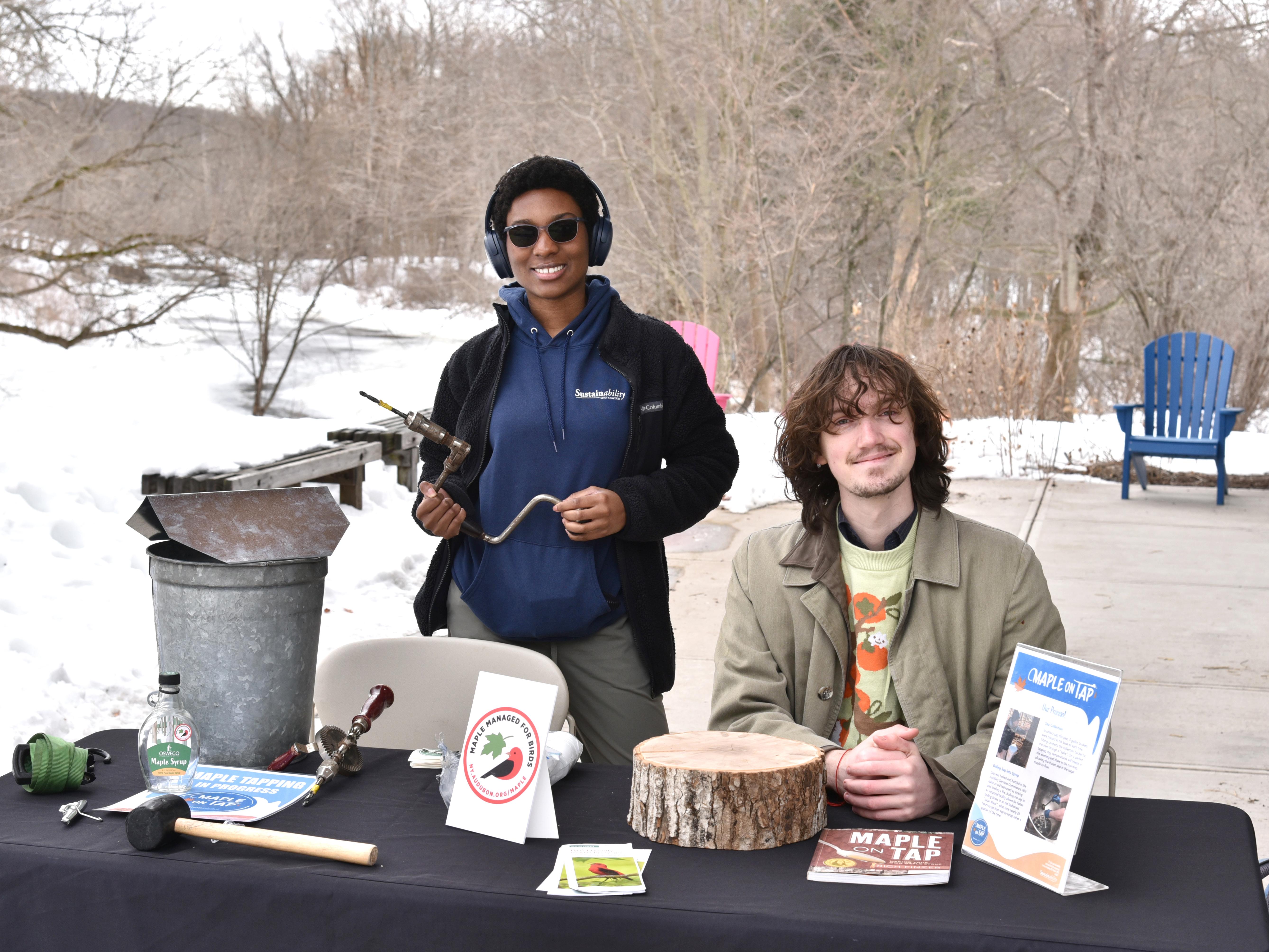
SUNY Oswego's ongoing sustainability initiatives earned continued recognition in Princeton Review’s "Guide to Green Colleges" for 2026. Oswego's many projects include educational outreach and practical activities including its Maple on Tap program, which produces gallons of maple syrup while hosting an Earth Day Pancake Breakfast after harvesting a large quantity of sap. Here spring 2025 sustainability interns (from left) Josephine Ragland and Barnaby Hurst showcase some of their maple tree tapping tools during Rice Creek Field Station's "Fresh Air, Fresh Start" celebration last year.
SUNY Oswego’s range of sustainability activities once again earned recognition in Princeton Review’s "Guide to Green Colleges" for 2026.
Oswego is among 388 colleges in the U.S. and around the world to receive high rankings for exceptional programs, policies and practices related to sustainability and the environment.
“Sustainability is increasingly becoming an important way of life for today and for generations to come,” said Kate Spector, the university’s sustainability director. “This recognition is wonderful, but the shared Laker spirit in solving real challenges and making real change is the true prize.”
The university’s many initiatives related to sustainability connect in pursuit of a common goal: to reduce the environmental impact on the planet while gaining opportunities through creativity, shared decision-making and purposeful activities.
“It’s sometimes challenging because some people contextualize sustainability as having to give things up, while it’s really about gaining new opportunities and ways of living that are friendly to the planet, other humans, animals and plants,” Spector said. “Our recognition as a Bee Campus and Tree Campus, for example, shows how supporting the environment can benefit us all.”
The Bee Campus USA designation, earned in October 2024 and continuing going forward, is designed to marshal the strengths of educational campuses to support the pollinators who play a crucial role in the food chain and overall ecosystem. The recognition notes the current work SUNY Oswego does and pledges to do to create a landscape in both Rice Creek Field Station and the lakeside campus to support the important work of pollinators.
Now in its second year, SUNY Oswego’s Tree Campus Higher Education recognition from the Arbor Day Foundation honors a commitment to effective urban forest management. SUNY Oswego regularly takes part in a number of events and activities, including Arbor Day plantings, programs and tree giveaways; a Maple Breakfast using sap harvested on campus; and raising awareness of the benefits of plentiful and well-maintained trees.
The campus also continues to be a leader in alternative energy, thanks in part to establishing a robust geothermal exchange system that will use the earth’s temperature variations to drive heating and cooling of campus buildings. This transformative step forward received $30 million in funding from New York State Gov. Kathy Hochul, supported by funds from the state’s Clean Water, Clean Air and Green Jobs Environmental Bond Act of 2022.
Another key ongoing campus project reflecting green goals involves Hewitt Hall renovations to convert it into a top national facility for the College of Communication, Media and the Arts, which reopened in fall 2025. Designed to meet stringent Leadership in Environmental and Design (LEED) specifications, this high-profile work incorporated sustainability starting in the planning phase and included the installation of the second geothermal energy grid on campus, complementing the one that was part of developing the Shineman Center.
Future renovations to Mahar and Lanigan Halls, as well as Penfield Library, will unfold using environmentally friendly processes and materials while also connecting to the expanded campus geothermal field.
Sustainability initiatives
The university’s many initiatives related to sustainability connect in pursuit of a common goal: to reduce the environmental impact on the planet while gaining opportunities through creativity, shared decision-making and purposeful educational activities.
SUNY Oswego is in the process of working toward a major in sustainability studies, expanding upon its popular current minor. The major would take the minor’s requirements in scientific principles, society and equity, and add humanities courses related to writing and storytelling, science communication and data-related skills. Expected graduates would build in-demand skills equipping them to work in the private or public sector in a growing field.
Oswego’s emerging Great Lakes Institute continues to serve as a resource to the university, the region and beyond by creating a greater awareness and understanding of the largest freshwater system on earth through research efforts, academic content and collaborations among students, faculty, staff and the greater community.
SUNY Oswego also received a grant from the U.S. Department of Agriculture’s Forest Service’s Great Lakes Restoration Initiative to develop an urban food forest, planting 300 native, edible and climate-adaptive trees and shrubs that also address stormwater runoff. With students, faculty, staff and community members involved in planting and sustaining the trees, including an expansion of the university’s Centennial Arboretum, this provides opportunities for education and engagement.
Rice Creek Field Station’s many activities and opportunities for visitors of all ages received a boost from a variety of funders for a major trail accessibility improvement project. Ongoing work will provide more accessible and inclusive spaces to engage a wider variety of community members, thanks to support from SUNY’s Outdoors for All program, Rice Creek Associates, the Shineman Endowed Fund at SUNY Oswego, the Richard S. Shineman Foundation, the Gifford Foundation, Brookfield Renewable and lumber donations from Worden Hill Construction.
“There’s a really social aspect to sustainability that we should never overlook,” Spector noted. “So many of us enjoy natural spaces, like Rice Creek Field Station or Lake Ontario, whether individually or with our family and friends, and making wise choices means we can continue doing so.”
Partnerships also include a Constellation Leading Environmental Accelerators Network (CLEAN) grant supporting future years of Rice Creek Field Station, playing a key role in the Canal Forest Restoration Project initiative to restore white oak, swamp white oak and white pine trees to areas along the New York State canal system, including Oswego.
The Office of Sustainability continues to find new and innovative ways to create opportunities, reduce waste and develop education. Other recent noteworthy accomplishments include:
- Continuing its award-winning Comp(Oz)t program, a partnership with Auxiliary Services that turns around 100,000 pounds of food waste annually into compost
- Diverting nearly 30,000 pounds of usable goods through the OzThrift program, where items left behind by students while moving out are repurposed into bargains for the campus and community
- An ongoing partnership with Auxiliary Services and a SUNY Oswego Native American studies course for its Maple on Tap project, which produces gallons of maple syrup while hosting an Earth Day Pancake Breakfast after harvesting a large quantity of sap
- The vibrant Permaculture Living Laboratory, a community garden space with a diverse array of fruits and vegetables
- Coordinating the pickup of hundreds of pounds of litter through the Shining Waters Program
- Serving hundreds of students through a fleet of 100 bikes in the BikeShare program
- A new hardcover book recycling project diverted 15,000 pounds of books away from landfills and toward specialty recycling
About the Green Colleges guide
“Among the hundreds of schools we surveyed for this project, SUNY Oswego, which offers excellent academics, is also a stand-out for its record of environmentally-responsible practices. We are delighted to recommend it to college applicants who want their ‘best-fit’ college to also be a 'green' one," said Rob Franek, The Princeton Review's editor-in-chief.
The Princeton Review chose the colleges based on a survey the company conducted in 2024–2025 of administrators at hundreds of colleges about their institutions' sustainability-related policies, practices, and programs. The company also surveyed students attending the colleges about their "green" campus experiences. The school selections were based on more than 25 data points from the surveys.
For more information or to check out the 2026 “Guide to Green Colleges,” visit www.princetonreview.com/green-guide.
SUNY Oswego also remains a mainstay in other Princeton Review guides, including its “2025 Best Regional Colleges” guide. Oswego has earned this designation every year since the educational services firm started regional listings in 2003.
For more information on SUNY Oswego’s green efforts, visit the Office of Sustainability website.