



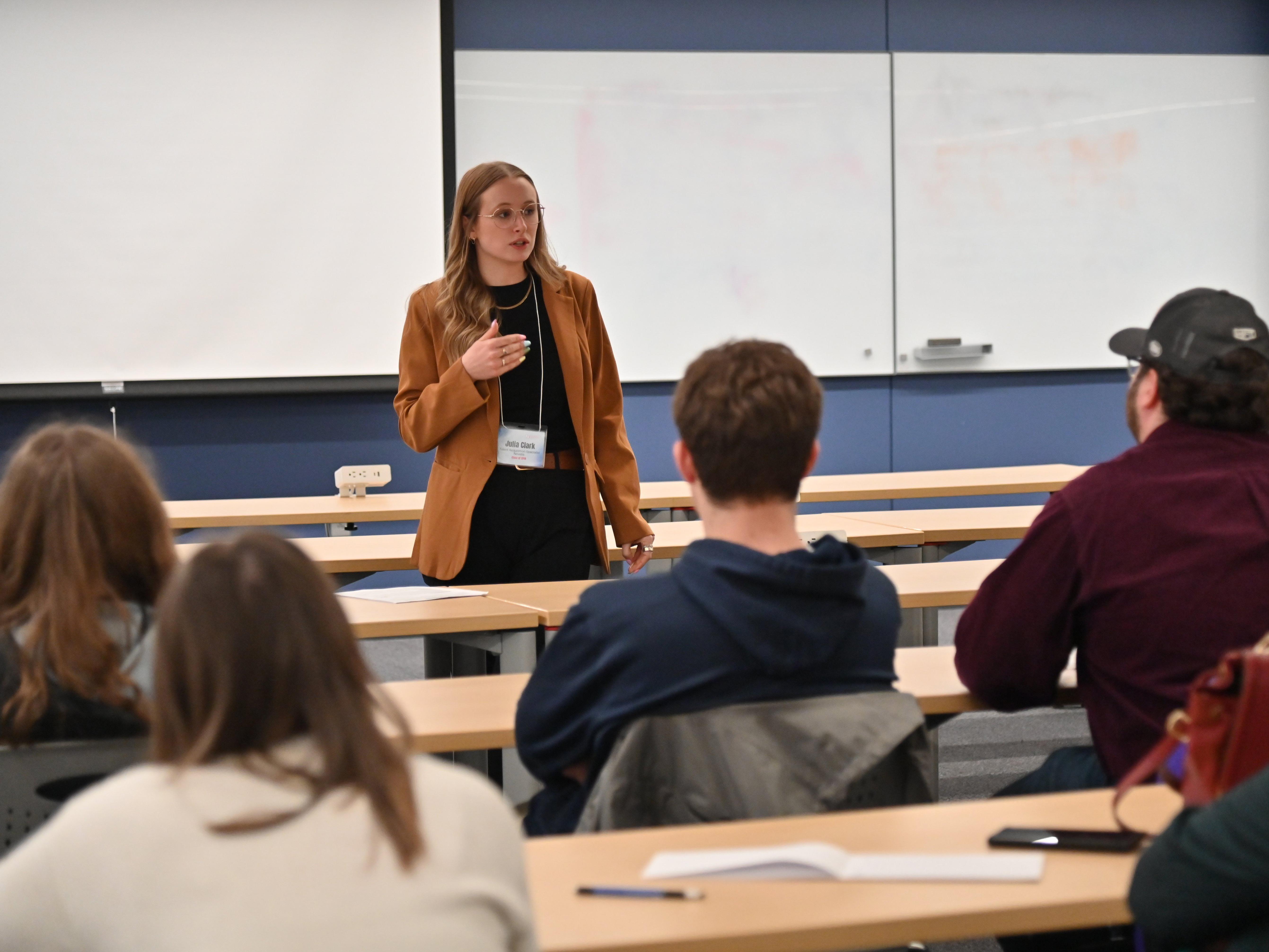
Julia Lavery Clark of Novelis, a 2018 SUNY Oswego graduate, speaks to students during the recent “AI and the Future of Work” summit.
At a moment when artificial intelligence is rapidly reshaping industries, SUNY Oswego brought together alumni and industry leaders to help students and the broader Laker community make sense of a changing workforce during the “AI and the Future of Work” summit.
Hosted by Career Services, the early April event in the Hewitt Hall Ballroom focused not on whether AI should be embraced, but on how to navigate a future where it is already embedded across nearly every field.
“We’re living through what futurists call a ‘popcorn moment,’” said Gary Morris, director of Career Services, in his opening remarks. “The heat is rising, and innovation is about to burst… This isn’t about fear, it’s about opportunity.”
Shifting entry point
A central question of the opening panel: Is AI eliminating entry-level jobs?
The answer, according to panelists, is more nuanced than headlines suggest.
“AI is definitely affecting hiring more than it is affecting layoffs,” said Diana Pena, senior economist with the New York State Department of Labor. “Companies are not necessarily letting people go … they’re just not backfilling entry-level positions. So it is a quieter displacement.”
Rather than widespread job loss, panelists described a restructuring of the traditional career ladder, particularly the early rungs.
“We are not just losing jobs, but we are losing the ladder,” Pena added, noting that as routine tasks become automated, the apprenticeship-style learning model may be at risk.
Jeff Knauss ’07, CEO and co-founder of Arcovo AI in Syracuse, reinforced that shift from an employer perspective.
“It’s not so much that people are being laid off,” Knauss said. “It’s more so that when someone retires … companies aren’t hiring a replacement because those tasks have been automated.”
Shifting skills sought
Across industries, panelists agreed that AI is transforming, not eliminating, work by taking on repetitive, administrative tasks.
“AI is taking on more routine tasks,” said Jared Wohl, senior account director at LinkedIn. “Which means entry-level roles are being evaluated less on basic responsibilities and more on critical thinking, communication and the ability to use AI tools effectively.”
That shift is already visible in hiring trends. According to LinkedIn data shared during the panel, demand for AI-related skills is growing rapidly, while human-centered skills remain just as critical.
“The play isn’t to avoid AI,” Wohl said. “It’s to lean into it … pairing AI literacy with those human skills and showing the impact you can create.”
Knauss emphasized that point even more directly.
“If you can become an AI native, you actually have more opportunity,” he said. “Organizations don’t know this technology yet. There’s a massive opportunity for people who are willing to learn it.”
Panelist David Kahn of SUNY Oswego's Campus Technology Services said the university has made AI-tools Gemini and NotebookLM available to the campus community, and many programs, such as the Adobe Creative Suite and Zoom videoconferencing widely used by students, faculty and staff, have AI tools embedded in them.
Who's most impacted?
While AI’s reach is broad, some sectors are seeing more immediate disruption.
Pena pointed to information, finance and professional services as particularly vulnerable, especially roles centered on data processing and administrative work.
Knauss added that the impact is less about industry and more about tasks.
“Every business is trying to solve the same kinds of problems — sales, marketing, invoicing, customer experience,” he said. “Anything that involves data moving from one place to another … AI is really good at that.”
Rethinking career preparation
As traditional entry-level pathways evolve, panelists encouraged students and alumni alike to rethink how they build experience and demonstrate value.
Wohl highlighted the importance of showcasing skills over titles.
“Your profile is a living skills record,” he said. “Show the projects you’ve created, the skills you’re developing and the outcomes you’ve driven.”
He also stressed the continued importance of networking, noting that candidates are significantly more likely to be hired when they have connections within an organization.
“It’s no longer optional,” Wohl said. “It’s part of the job search advantage.”
Knauss encouraged students to go even further by actively building with AI tools rather than simply learning about them.
“Don’t read a book,” Knauss said. “Go to the AI and ask it how to use it. It’s never been easier to learn.”
Expanding access and opportunity
Panelists also highlighted how institutions and policymakers are responding.
New York State initiatives such as Empire AI and the CUNY AI Innovation Fund are expanding access to training, microcredentials and hands-on learning opportunities across disciplines.
“These are not just awareness programs,” Pena said. “They include real training, real credentials and real experience … but students have to take advantage of them.”
SUNY Oswego President Peter O. Nwosu announced in early 2025 that the university would become an AI campus, marking a campus-wide effort to thoughtfully integrate AI across academics and operations.
In 2023, SUNY Oswego was the first higher education institution to offer a course on using ChatGPT for business, according to management and marketing faculty member Mohammad Tajvarpour, who developed and taught the course before becoming one of 20 members in the inaugural class of SUNY’s AI for the Public Good Fellows in 2025.
Practical real-life applications
After the panel, attendees at the summit also had the opportunity to attend one of two break-out sessions:
- "Recruiter Secrets: Don’ts of AI and What They Really Want to See" with Julia Lavery Clark ’18, talent acquisition specialist, Novelis
- "Mastering AI in Your Job Search: Better Results with a Human Touch" with Pam Skillings, chief product officer, Big Interview
Following the break-out sessions, attendees returned to the ballroom to participate in an AI Career Connection Spotlight. During this portion, students and others explored real-world AI applications from local leaders and heard from students who explained their AI-related projects through poster presentations. They also enjoyed refreshments and were entered to win a pair of Meta Headliner Eyeglasses.
Despite uncertainty, the tone of the summit remained optimistic. Panelists consistently returned to the idea that AI is not replacing human potential: it is reshaping how it is expressed.
“The future isn’t less human,” Morris said. “It demands more of what makes us human — critical thinking, creativity, empathy and the courage to keep learning.”
For SUNY Oswego alumni, many of whom are already navigating this shift in their own industries, the message resonates: adaptability, curiosity and a willingness to evolve are no longer advantages — they are essentials.
“The one thing you can control is your effort,” Knauss said. “Do the extra work, learn the tools and that’s what will set you apart.”
-- Submitted by University Advancement