



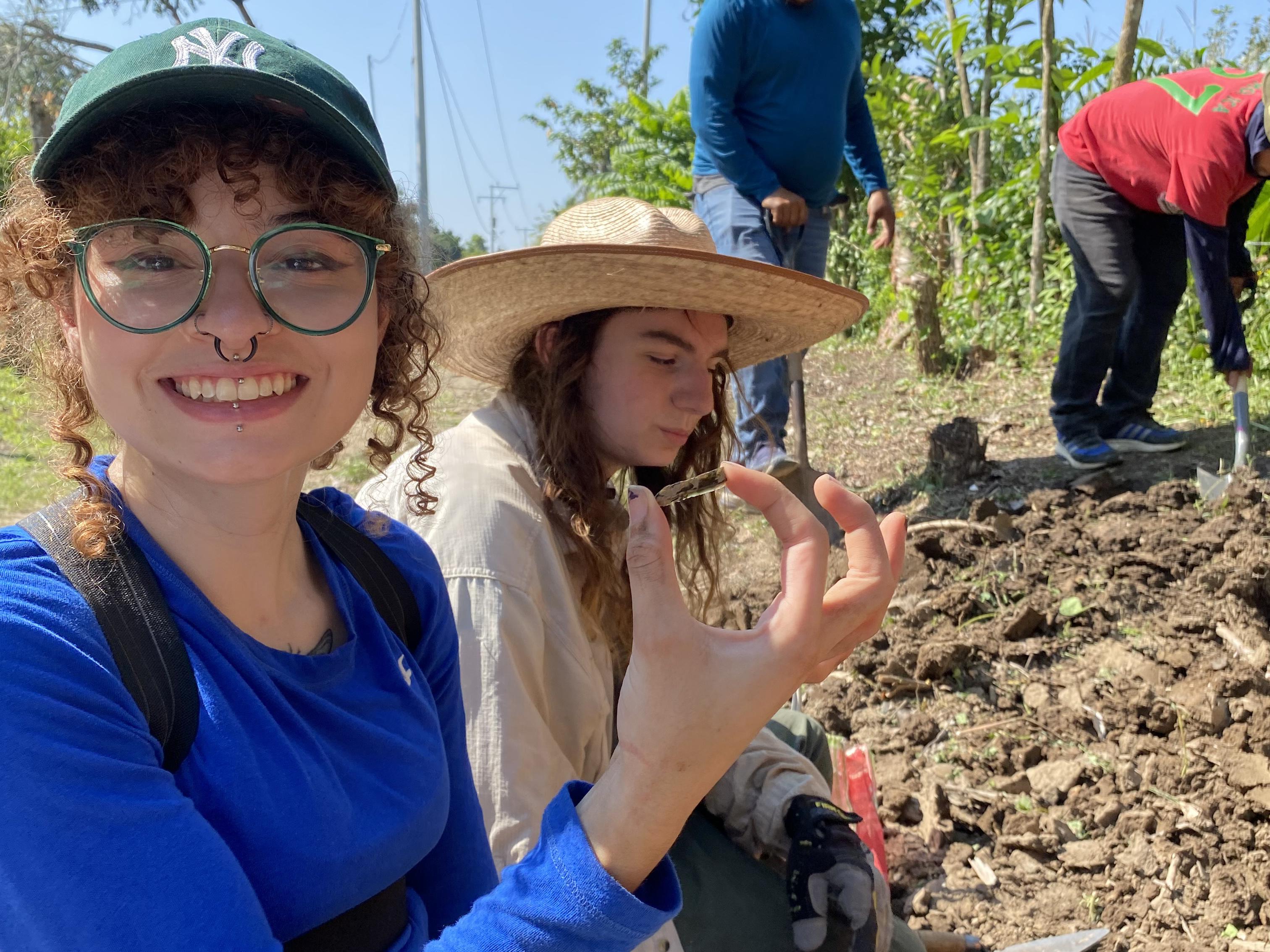
Anthropology major Jylene Figueroa holds up a discovery from a dig earlier this year in Veracruz, Mexico, as part of a National Science Foundation-funded research project.
SUNY Oswego students had the opportunity earlier this year to perform archaeological research in Veracruz, Mexico, as part of a National Science Foundation-supported project led by anthropology faculty member Alanna Ossa to explore the development of ancient markets.
The project that probes the history of open market exchange and economic development in the Gulf Coast area of Veracruz, Mexico –- while also providing student research opportunities and shedding light on what this means for modern communities.
A three-year $180,000 National Science Foundation grant supports Ossa and SUNY Oswego students conducting field research, working with Mexican researchers and college students, and building a database that can serve people around the world. The project collects and analyzes individual household data from the Late Classic (700 to 900 A.D.) era with Middle Classic (1200 to 1350) conditions.
Jylene Figueroa and Joshua Winoski, both anthropology majors with minors in Native American studies, recently discussed taking part in the first round of research, which happened from late December through most of January –- a time when the tropical temperatures were more manageable (albeit still fairly hot). Another anthropology major, Mackenzie Schmitt, joined them and Ossa for this paid student experience.
“Going to Veracruz with Dr. Ossa was a really great experience because I got to do some more archaeology and learn different things, especially being in a different country,” Figueroa said.
“I was really interested in getting more experience in the field of archaeology, and it served as a really good experience for deciding whether or not this is something that I wanted to do, and the answer is, yes, I very much want to do it,” Winoski said.
"From what I've seen over the years is that these hands-on field and research experiences are incredibly meaningful,” Ossa said. “They also help students figure out what they like doing and provide them with once in a lifetime opportunities for their career and life pursuits."
Students said the process involved mostly surface collections, not excavations, using trowels to only go down a few centimeters. Other team members will provide more thorough analysis on the retrieved pieces.
“It’s more of a survey project than an excavation, but honestly, it was incredible,” Winoski said. “Being able to hold stuff that's that old and trying to put yourself in the shoes of the people who used to live there, that was really cool.”
“We were kind of just collecting things and observing,” Figueroa said. “But I was really interested in the ceramics we found. We found a lot of figurines with faces, which is really popular there.”
The region and sites previously were unfamiliar to Winoski, who ended up fascinated by the history and what they were able to find, which included a lot of styles of obsidian, little blades and even figurine heads.
“I also ended up finding a chert arrowhead, and chert's not something that you really find in that region, according to the people that I talked to,” Winoski said. “And so it was brought in, probably from immigrants, traveling in and settling in that area. So that was really, really cool.”
After discovery, researchers try to solve the mystery of what a piece actually is, where it came from and how old it is.
“With ceramics, for example, you can try to find out what it's made up of, where it comes from, the time period, and it can tell you a lot of things, like were people transporting things there or were they making it there,” Figueroa explained. “Essentially where they come from can tell you, different story. Because while you might find it there, but that doesn't mean that's where it's from.”
These discoveries are pieces of a larger puzzle -- how markets led to economic and community development centuries ago, and how this process relates to modern dynamics in development.
In a way, these were research treasures almost hidden in plain sight, which made the experience even more remarkable.
“People have just built houses around or on top of these mounds we were studying,” Winoski said, as the project received permission from residents for the exploration. “So it's kind of literally in their backyards. So we would just go to somebody’s yard or cow pasture while people have continued just living there for however long.”
Professors supporting journeys
While Figueroa did not come to Oswego originally for anthropology, taking it as a major dovetailed with some lifelong interests.
“Growing up, I had a lot of questions about why people did things, and wondered why they didn’t do things a different way instead,” Figueroa recalled. “And it really was just me thinking about social structures, but then actually learning and being in the classes, I was like, ‘oh, I actually really like this,’ and I'm able to answer the type of questions that I've always been thinking of. And what I've done with anthropology and archeology is kind of combine those interests.”
Figueroa really appreciates the department’s support and opportunities, which included going to Peru with another faculty member, Jordan Dalton for what evolved into a senior research thesis.
“It was a really cool experience because she really helped me dig into my interests,” Figueroa said. “I used that data to kind of talk about colonialism, and how bringing different animals to the land changes land usage and what people eat.”
After May Commencement, Figueroa has received a job offer to continue archaeological work with Tetratech and later go to graduate school, ideally for maritime archaeology to set up further research.
“I really want to work in the Caribbean, because that's where my family is from, from DR [the Dominican Republic] and Puerto Rico, and I want to study the indigenous people, the Taino,” Figueroa noted.
Winoski, meanwhile, returns to continue studying in the fall to continue to build an already-impressive resume of fieldwork that also included working in Kenya last summer with Oswego faculty member Patricia Princehouse as well as other local research.
Both students praised the anthropology faculty as not only outstanding teachers and researchers, but for being supportive humans as well.
“I feel like they're very understanding of our lives and that we aren't only students, but I work and have to support myself, and they really do their best to accommodate for those things,” Figueroa said. “So for the trip to Mexico, she was not going to let us do that unless we got paid for it.”
"They offer a lot of support for their students,” Winoski said of the anthropology professors. “You can tell that they really do care about their students.”
“I just feel like I have a really great relationship with them,” Figueroa said. “They're really easy to talk to. They will do anything to support you in any ways that they can. And I think they're just really great professors.”