




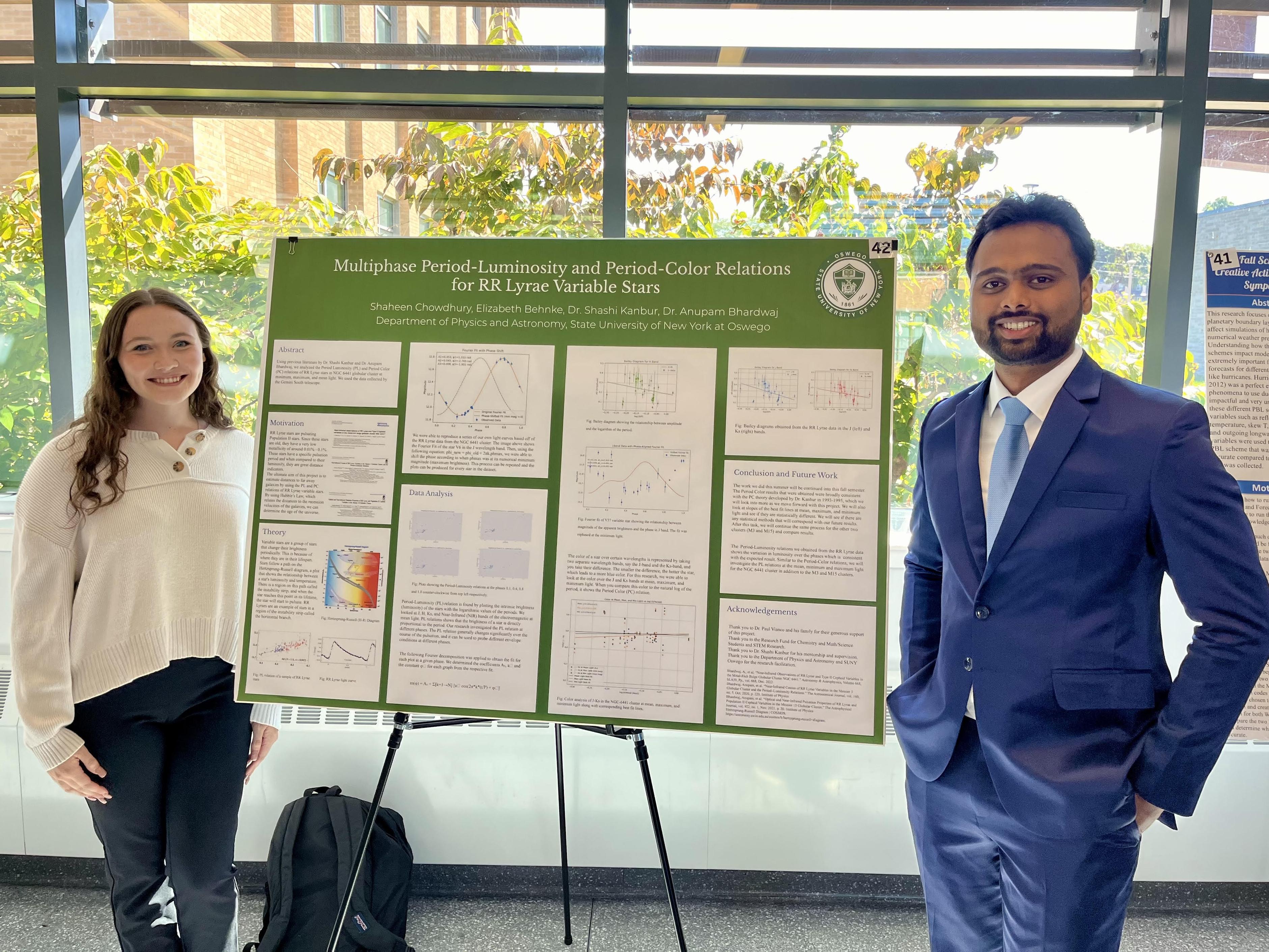
SUNY Oswego students Elizabeth Behnke and Shaheen Chowdhury present their research "Multiphase Period-Luminosity and Period-Color Relations for RR Lyrae Variable Stars," which uses variable stars to explore the size and age of the universe.
SUNY Oswego students Shaheen Chowdhury, a physics major, and Elizabeth Behnke, a chemistry major, have spent the past year immersed in a research project that looks at variable stars to understand some of the universe’s deepest questions.
Their work, conducted under the guidance of world-renowned Shashi Kanbur, a SUNY Oswego Distinguished Professor of Physics and Astronomy, focuses on variable stars, stars that fluctuate in brightness over time, and the mathematical relationships hidden within those patterns. Kanbur’s work and main research centers around stellar pulsation.
In putting together their project, titled "Multiphase Period-Luminosity and Period-Color Relations for RR Lyrae Variable Stars," Chowdhury and Behnke are working with data collected by a telescope in Chile, drawing on research published by scientists and former students of Kanbur. “We’ve been going through the papers that [Kanbur’s] students published,” Chowdhury said, “We’ve been performing our theoretical analysis and also the simulations we’ve been doing with coding.”
Variable stars are central to the study of cosmic distance and expansion -- and crucial questions on the size and age of the universe. “Variable stars are basically like pulsating stars that go up and down in brightness,” Chowdhury said. “By time period, I mean the time it takes for the star to go from high brightness to low brightness, and again coming back to the same original high brightness state.”
The research centers on two key astronomical tools: the period-color and period-luminosity relationships. Behnke is focusing on period-color while Chowdhury studies the latter, a fundamental concept first discovered by astronomer Henrietta Leavitt. This semester, Oswego’s Theatre Department did the play “Silent Sky” that follows Leavitt’s work at the Harvard Observatory. As a bonus, Behnke and Chowdhury had the opportunity to showcase their research poster in Tyler Hall to complement the lessons of the production.
“[Leavitt] was a phenomenal scientist and despite all the obstacles, she still kept going,” Chowdhury said. “[Leavitt’s] work is so fundamental that without this relationship, we wouldn't be able to see how these stars are going farther and how this overall relates to the bigger impact, such as getting the distance and also getting the age of the universe.”
Donor support key
The project began over the summer with funding from Oswego alumnus Paul Vianco, who spent 35 years as a researcher and retired as a senior scientist at Sandia National Laboratories in Albuquerque, New Mexico. With Vianco’s funding, students could work full-time on the data drawn from the Chilean telescope.
“Our project wouldn't be possible without Dr. Paul Vianco’s contribution,” Chowdhury said. “He allowed us to work and continue our research in the summer, and we had a huge head start because of that.”
After their summer presentation, Behnke, Chowdhury and other students had lunch with Vianco and faculty members.
“It was a great experience talking to our research donor,” Chowdhury said. “Hearing his perspective and motives about why he funded our project and why it's important. Having a professional conversation together with the faculty really helped me have a different perspective towards, you know, everything.”
The team’s primary dataset comes from the globular cluster NGC 6441, although they plan to expand their analysis to clusters M3 and M15 later in the capstone project. The research involves comparing star behavior across clusters, including their metallicity, a measure of elements heavier than hydrogen and helium.
“In astronomy, we consider anything other than hydrogen and helium to be metal,” Chowdhury said, noting that the term differs from its chemistry definition.
Chowdhury’s interest in astronomy grew through an earlier independent study, where he was first introduced to stellar-evolution software and guided through foundational research tasks. He eventually worked alongside Behnke when he was a teacher’s assistant in one of Kanbur’s classes. “We were learning how to do different star evolutions and how big stars and small stars do different kinds of evolution,” Chowdhury said.
Now, Behnke and Chowdhury plan to continue refining their analysis, compare additional clusters, and prepare their results for possible publication. “If we find anything statistically significant, then we plan to publish it,” Chowdhury said.
The project, Chowdhury adds, has shaped not only his academic path but also his confidence as a researcher.
“This project really helped me a lot,” Chowdhury said. “Having the opportunity to work with professionals gave me insight into what real research looks like.”
-- Written by Natalie Glosek of the Class of 2026