



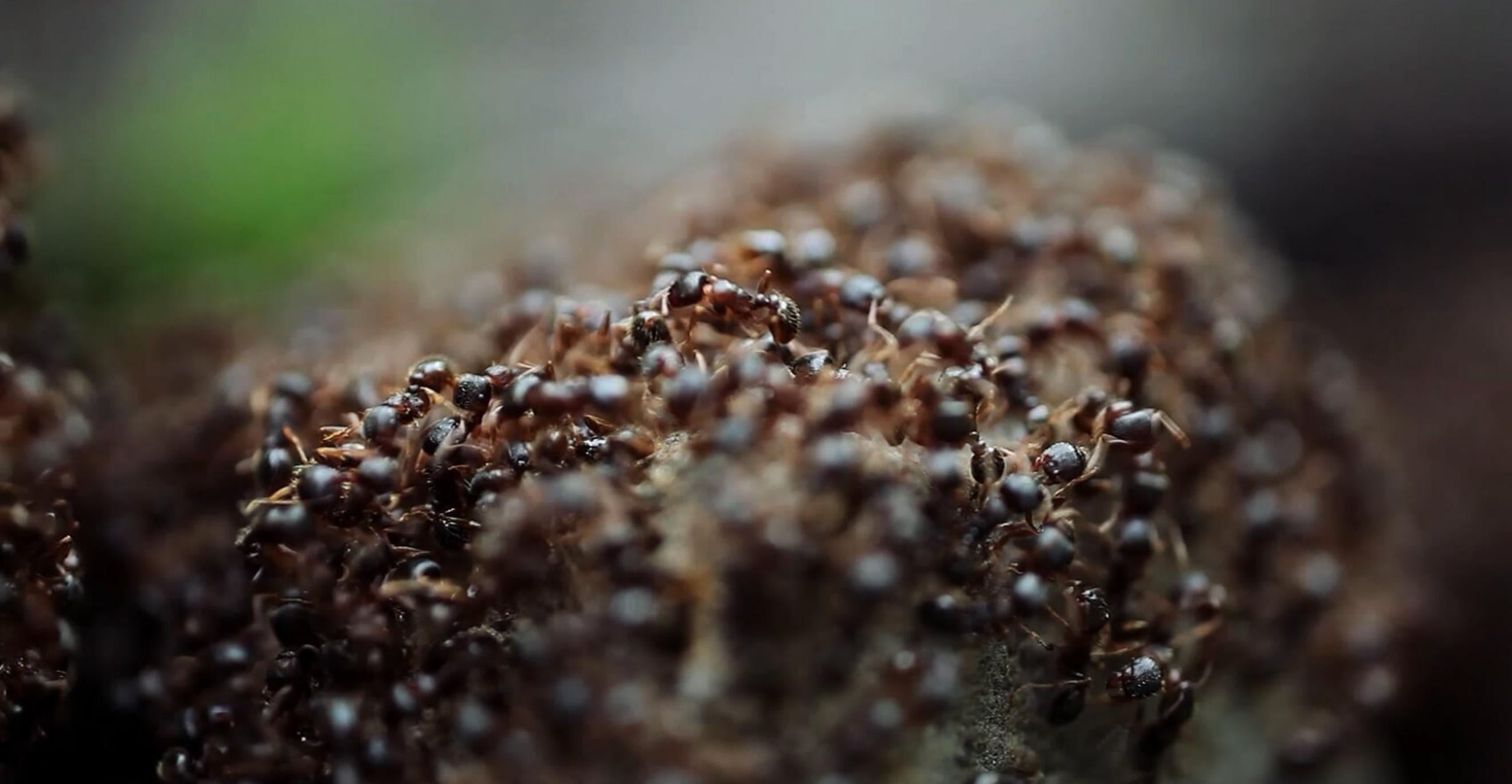
A video still of insects during a Kansas ice storm from Tiffany Deater's video exhibition, “What Lives Underneath,” currently running at the National Museum of Wildlife Art.
SUNY Oswego cinema and screen studies professor Tiffany Deater has created a three-video installation observing the natural world, appearing at the National Museum of Wildlife Art.
The exhibit, “What Lives Underneath,” opened in November and will appear at the museum until Jan. 4, 2026.
Deater describes the pieces as video essays, each asking how people navigate life through their encounters with the natural environment. “There’s something comforting about sitting out in the woods and just watching all of the other creatures live their lives,” Deater explained. “It brings me peace.”
Much of the imagery that makes its way into her films comes from spontaneous shooting sessions: a spider carrying her babies or even a robin whose beak had frozen to a telephone wire during an ice storm.
“[The robin] was the most fascinating thing I’ve filmed,” Deater said. “I went out to see what the world looked like, covered in ice, and there was that robin just hanging from the line.”
At SUNY Oswego, Deater’s teaching intertwines closely with her filmmaking practice. She teaches production courses, “Cinema and the Environment,” and an upcoming VR course she will co-teach with her partner, professor Jared Hagadorn, with whom she also collaborates artistically.
Deater and Hagadorn have spent years cultivating an ecocinema minor, supported in part by a National Endowment for the Humanities grant. They have also led immersive study experiences for students in the Adirondacks and South Africa.
Deater’s time in the classroom reinforces her values of careful attention to the world in connection to filmmaking.
“You need to be observant to be a better filmmaker,” Deater said. “Look at the way tree bark patterns form, the colors of the afternoon light or the sounds of cicadas telling you it’s late August.” These small details, Deater said, can define the emotional and ecological truth of a scene.
While Deater has traveled across the world filming birds in New Zealand and large mammals in South Africa, she says her heart remains in the forests near home.
“We’ve filmed lions and zebras and magnificent animals,” Deater said, “but the forest is where my heart is. You can spread half my ashes in the Namib Desert, but most of them belong here.”
Lifetime of caring
The project’s roots stretch back to Deater’s childhood, when she spent long hours exploring fields near her home and caring for insects and small pets. Although she initially planned to become a veterinarian, her studies in biology led her to rethink that path. A later shift to literature and film studies opened an unexpected door.
“I think ‘Tropical Malady’ was the first film where I thought, ‘Wow, I want to try to make a film,’” Deater said.
Film combined her interests in writing and painting, but also gave Deater a sense of safety. “I’m always behind the camera,” Deater said. “Even when I use my voice, I don’t feel like I’m really putting myself out there the way other forms of art might.”
One piece in her video essays, “Tornado Lake,” asks viewers to confront the ethics and contradictions of how humans treat different species. Drawing on the history of wildlife filmmaking, Deater raises questions about why society values some lives and disregards others.
One of the film’s most unsettling segments incorporates footage from a “RoboRoach” educational kit, which teaches children to control a living cockroach via implanted wires.
“If a cockroach ran across your kitchen, you’d stomp it,” Deater says, “but there’s something incredibly disturbing about watching a surgery on a live insect marketed to kids.”
As her work appears at the National Museum of Wildlife Art, Deater still feels a sense of disbelief.
“I thought the email was a scam at first,” she laughed. “But then I realized, my work is going to be next to what people consider ‘real art.’ And it makes me wonder, what even is real art?”
Through quiet observation and difficult questions, Deater hopes her films encourage viewers to rethink their relationships with the natural world.
“I hope people walk away thinking about how we treat animals, how we listen to the environment, and what our place really is in all of it,” Deater said.
To learn more about Deater’s “What Lives Underneath” or the museum, which is located in Jackson, Wyoming, visit the National Museum of Wildlife Art Website.
-- Written by Natalie Glosek of the Class of 2026