



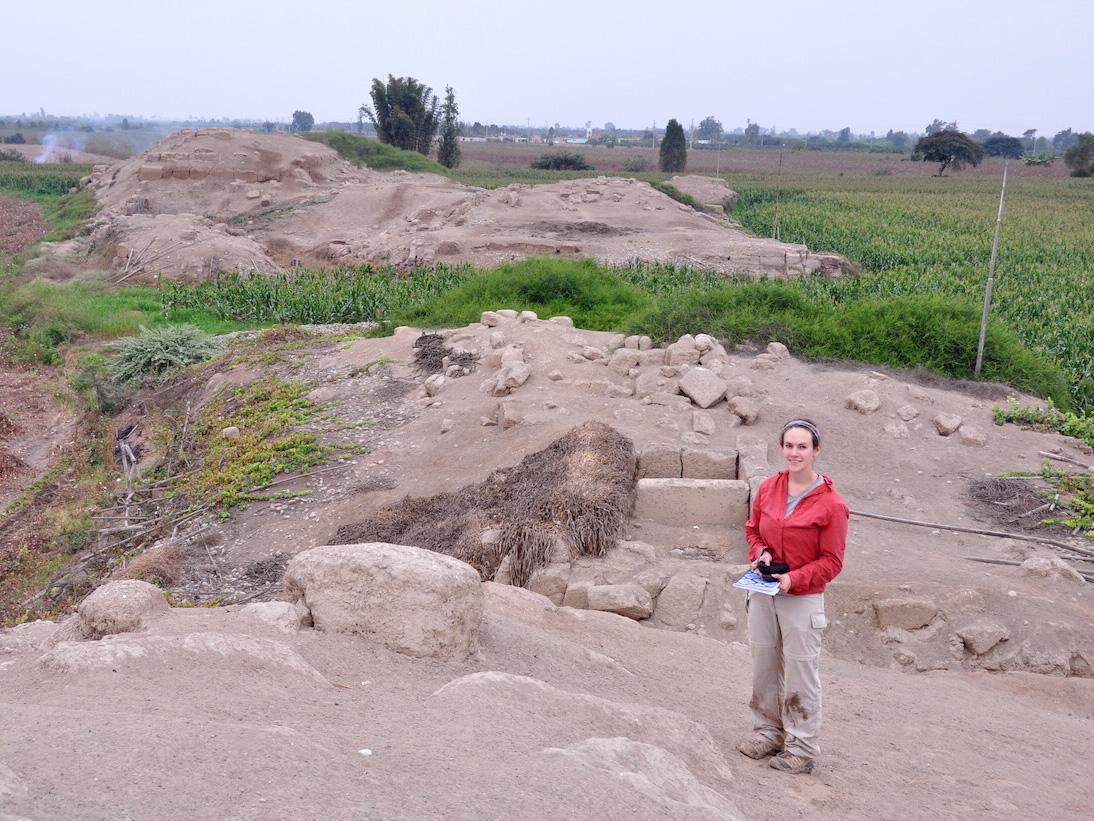
SUNY Oswego anthropology professor Jordan Dalton stands in front of a dig site during groundbreaking research in Chincha Valley in Peru.
SUNY Oswego anthropology professor Jordan Dalton co-led an international research team that found evidence for long-distance migration along Peru’s Pacific coast that began at least 800 years ago, centuries before the rise of the Inca Empire and much earlier than previously thought.
In research published in Nature Communications in collaboration with the University of Sydney from Australia, the team analyzed ancient DNA (aDNA) alongside archaeological and historical data to provide some of the strongest evidence to date of population movement along the Pacific coast prior to Inca rule (AD 1400 to 1532). The findings demonstrate that pre-Inca coastal communities were far more mobile and connected at local and interregional scales than historically believed.
The new research suggests people travelled more than 700 kilometres from Peru’s north coast to the Chincha Valley in the south. They then settled and intermarried with neighbouring populations, while maintaining distinctive cultural traditions –- such as cranial modification and painting the dead with red pigment –- for generations. The study also identified a single grave containing relatives who engaged in endogamy, procreating with close kin.
“Migration and kinship have long been part of the human story and the development of powerful societies,” said co-lead author Jacob Bongers, digital archaeologist and member of the Vere Gordon Childe Centre at the University of Sydney, and visiting research fellow at the Australian Museum Research Institute.
“What’s most interesting about this research is that it shows the close-knit and far-reaching social networks of pre-Inca coastal communities, as well as how people maintained cultural traditions of marking group identities for centuries, even as they intermarried with distinct groups,” he said.
The research team analysed aDNA samples of 21 individuals recovered from burial sites in the Chincha Valley to reconstruct family relationships and explore genetic diversity over time.
“The genome-wide data and radiocarbon dates suggest migrants arrived in the Chincha Valley by at least the thirteenth century AD, well before Inca expansion,” Bongers said. “Their ancestry traced back to the Peruvian northern coast, more than 700 kilometres away, and the aDNA of these early migrants revealed no evidence of mixing with local populations.”
Genetic evidence revealed mixed ancestry between people from the north, central and south coasts over subsequent generations.
“This likely means that, after northerners migrated to Chincha, they intermarried with groups from neighbouring coastal areas, a practice that continued during the Spanish Colonial Period (AD 1532-1825),” Bongers said.
“The close biological relationships suggest the sampled individuals were members of an ayllu or parcialidad, a traditional, kin-based group that shares common territory, resources and ancestry,” Dalton said. “Close-kin unions may have served as a strategic means of retaining control over resources within the group.”
Dalton compared this to the way, for example, the British monarchy tended to maintain rule by marrying within the family to maintain their power base.
Longstanding research partnership
Dalton has participated in research in Peru since her undergraduate days at University of California, San Diego, which had a field school in Moquegua, Peru. At the time, Dalton had an interest in archeology and a minor in Spanish literature, so the project fit with her greater interest.
The research has allowed Dalton to provide experiences for Oswego students, including May graduate Jylene Figueroa for what eventually evolved into Figueroa’s senior research thesis.
“Jylene worked with some material from an excavation that I did in 2023,” Dalton said. “We were kind of trying to understand the history of occupation at the site. The site is covered by modern-day agricultural fields, so she looked at some of the units where we dug under the fields, and found some evidence for occupations and architecture under modern fields, while some didn't have any evidence.”
“It was a really cool experience because she really helped me dig into my interests,” Figueroa said. “I used that data to kind of talk about colonialism, and how bringing different animals to the land changes land usage and what people eat.”
In addition, Dalton noted that this kind of research benefits her skillset and knowledge base as a teacher and mentor, which translates positively for Oswego students.
“I think it helps them engage with the modern discussions that are happening in archaeology, and ancient DNA is one of those leading fronts,” Dalton noted. “What it does to help me, and also helps students, is when I'm really interested in a particular problem or research question, I often integrate aspects of that into class, and I think that that leads to a lot better discussions.”
Some of those research questions, such as whether or not ancient Peru had money or another currency system, Dalton introduces into anthropology classes for students to explore.
“It's a little bit of a debate, and when I brought that into class for students to discuss with some of my own research questions, I feel like it helped me set up a better structure for them to debate in, as well as their ideas were really interesting for me to think about, too,” Dalton said.
“I think there's cross-pollination when we as educators and researchers are actively engaging in topics that we're interested in for our research,” Dalton said. “I think it helps the students become more engaged, and then I think the students also help us become more engaged and think about questions from new perspectives.”
Digging deeper
The research found that all sampled individuals had some north coast ancestry, demonstrating population continuity for at least 200 years. This coincides with persistent cultural traditions maintained in Chincha from at least the thirteenth to fifteenth centuries.
“In the sampled individuals from the lower and middle valley we observed practices such as cranial modification, a process carried out in infancy to shape the head using boards and bindings, human vertebrae strung on reed sticks, and the postmortem application of red pigment to the skull,” Bongers said.
The timing of migration from northern Peru aligned with major social and political changes along Peru’s coast, yet the precise reasons for population movement remain uncertain, Bongers said.
“Climate hazards, the expansion of powerful northern polities such as the Chimú, and access to valuable resources such as seabird guano, are all possible drivers of ancient Andean migration,” he said.
“There is a lot of emphasis placed on connections between the coast and the highlands, and just specifically looking at movement across that plain,” Dalton said. “But this research really shows that there's a lot of underexplored richness in the types of migrations or social connections that were developed between coastal groups, and that we need to understand what was happening along the coast.”
Doing so can be more difficult, Dalton noted, because archaeologists will use the presence of non-local items to talk about trade and interaction, but along the coast, people had access to a lot of the same types of resources.
"Importantly, this research expands our understanding of how and when interregional interaction occurred along the Andean Pacific coast and makes it clear the Inca incorporated highly mobile and deeply connected coastal communities into their empire."
Dalton noted that the research is ongoing and productive, and will involve taking another SUNY Oswego anthropology student, Danielle Kemmett, to the site this summer.
“We're doing a little more community work, where we'll be presenting and engaging with the modern community that lives at the site now to help build better relationships where they can become more actively engaged in the research process,” Dalton noted.
“One thing that I really enjoy about working in Peru is there are a lot of Peruvian scholars that do really active research that engages communities,” Dalton said. “There are a lot of government agencies and museums that really try to build a connection between the modern communities and the past, and in places like Chincha, modern communities are right on top of where the old sites are.”