



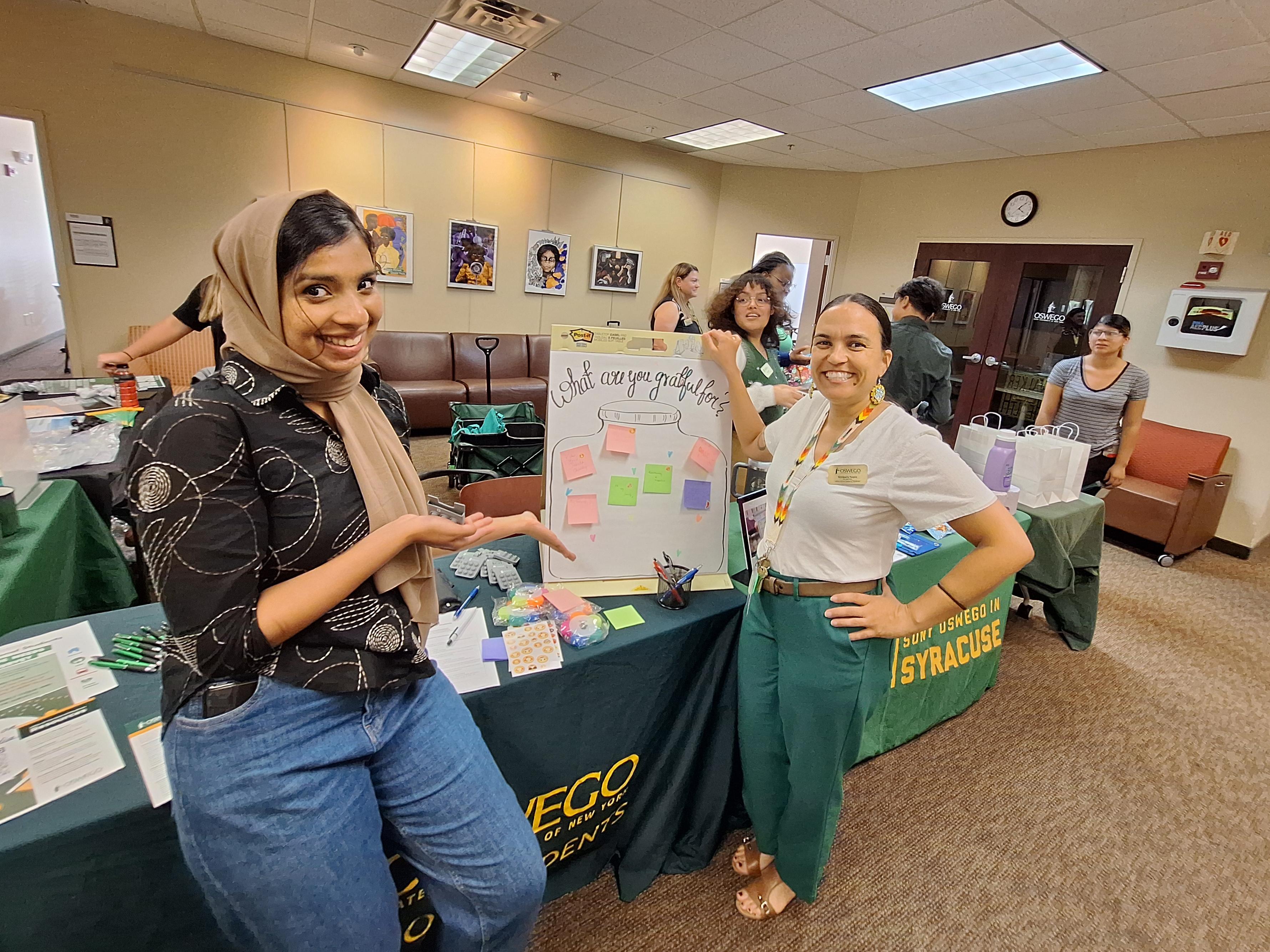
SUNY Oswego's initiatives in basic needs support were among those recognized by SUNY Chancellor John B. King Jr. earlier this month. Shown at an outreach event at SUNY Oswego's Syracuse Campus in the fall are Office of the Dean of Students representatives, from left, graduate assistant Sumayya Sagheer and Kimberly Fuqua, university homeless liaison; behind Fuqua is April Lopez, coordinator of the SHOP (Students Helping Oz Peers) pantry.
SUNY Oswego was among the institutions recognized for outstanding support and initiatives in student basic needs by State University of New York Chancellor John B. King Jr. on Jan. 2.
Oswego’s actions and programs supporting housing security put the university among the 17 campuses King praised for assisting students with housing, food and transportation support. The initiatives will take place during the spring 2026 semester and will be evaluated for further expansion.
SUNY announced that its partnership with SchoolHouse Connection will include intensive support for three campuses to implement projects to address housing insecurity, with Oswego one of the campuses leading the initiative.
Homeless liaisons have been in place on each SUNY campus since 2023 to ensure students experiencing homelessness receive the academic, financial and wraparound support they need to succeed and thrive. SUNY is partnering with national experts at SchoolHouse Connection to provide individualized technical assistance for how campuses can meet the needs of students facing housing insecurity.
Christy Huynh, dean of students and assistant vice president for student affairs, praised the work of Kimberly Fuqua, Oswego’s homeless liaison, and April Lopez, coordinator of the SHOP (Students Helping Oz Peers) pantry, as shining examples supporting SUNY’s emphasis on access and student support.
“Kimberly meets individually with each student to discuss their situation and what resources are available to support housing, food and transportation insecurities,” Huynh said.
Fuqua’s role as homeless liaison means connecting any student facing housing insecurities and with on-campus and off-campus resources both on and off campus.
Supporting student success
“Most of these students are first-generation students who have trouble navigating the higher ed landscape,” Fuqua noted. “I think it’s very important to educate the students, faculty and staff about the definition of homelessness or housing insecurity to avoid stigmas around the issue so that students can reach out for help, and be successful so we can retain those students to graduation.”
Fuqua assists students with funding for school supplies, books and technology, as well as emergency funding needs and transportation issues. She also refers students to the SHOP (Students Helping Oz Peers) pantry –- the first campus pantry in SUNY –- in Penfield Library on the lakeside campus and its branch on the SUNY Oswego Syracuse Campus.
“Sometimes, I am just a listening ear and in the moment –- that is what is needed,” Fuqua noted.
Grace Maxon-Clarke, associate dean of students, noted that Oswego was “hand-picked by Chancellor King to participate in a SUNY-wide homelessness work group — the very first of its kind across the system.”
Under the Individualized Technical Assistance (ITA) for Housing Insecurity Initiative, Oswego is marshaling its resources in ways to not only improve resources for Oswego students but to help provide a model for the rest of SUNY.
“Part of our charge is to work closely with Pearl Strategies and SchoolHouse Connection, who will provide consultation on our current efforts and help us develop creative strategies for the future,” Maxon-Clarke said.
The Oswego team –- featuring representatives of the Dean of Students Office, Financial Aid, Residence Life and Housing, Experiential Learning and Financial Aid –- has met twice so far to start laying the groundwork, Maxon-Clarke said.
“We have had deep discussions about our available resources (on and off campus) and potential gaps in services,” Maxon-Clarke said. “Our next steps will include action plans to improve our critical student services and support both with housing and basic needs as a whole. It has been helpful to have the space to deep dive into what we do and what we could do better. We could not be more grateful for our campus partners who have stepped up to help us.”
“Any student experiencing housing insecurity can connect with the homeless liaison for support and referrals to resources,” Huynh explained. “Emergency housing on campus, the donor-funded Student Emergency Fund and summer break housing scholarships are a few of the resources in place to ensure students have access to safe and secure housing in order to successfully persist and ultimately graduate.”
All SUNY Oswego students regularly receive notifications on such topics as scholarship availability, break housing applications and key changes to transportation. Huynh said basic needs continue to grow, with Oswego’s efforts matching the rising need for help.
“Due to a growing need for students to stay on campus during breaks due to housing insecurities and transportation issues, Residence Life and Housing and Dining Services have updated their licenses so students can live on campus throughout the academic year without additional charges,” Huynh said. “In addition, Residence Life and Housing, Auxiliary Services and the Office of the Dean of Students provide housing and dining scholarships during the summer break to support students experiencing housing insecurity.”
Team effort
“I appreciate the recognition, but it truly is a team (college-wide) effort,” Fuqua said of SUNY’s praise for Oswego’s initiatives. “The work I do would be fruitless without the thoughtful work of all departments on campus. I am grateful and humbled by this work each day. Being in the shoes of my students helps me be a better listener and guide students towards greatness as others have done for me.”
Fuqua noted a number of success stories in her first year with Oswego, including assisting students with Tuition Assistance Program (TAP) applications and with the Free Application for Federal Student Aid (FAFSA), the latter in determining student independence to help them earn the maximum Pell Grant available (which can be difficult without a parent of advocate); creating an Basic Needs Resource Guide for international students; and working with Residence Life and Housing to identify students who might benefit from break and summer housing.
She also performs a comprehensive intake for students with emergency funding needs to determine how best to help, as well as connecting them with state and county resources when needed.
“Being Native American, I have a vested interest in the Native students on campus and their retention –- often assisting with their New York State aid from Albany,” she added.
“I am new to Oswego, so this work began before I got here,” Fuqua said, giving credit to Residence Life and Housing for acknowledging the growing need for break housing for students with adverse circumstances and doing what needed to be done to make break housing available for all students, embedded in their year-round cost.
“Special thank you to Auxiliary Services for providing free meal swipes, jobs and having a fund for us to use for school supplies,” Fuqua added. ”Thank you to Financial Aid for always assisting students with the steps to take for financial success.”
For more information on student basic needs support services, visit the Office of the Dean of Students website.
Under the leadership of the SUNY Board of Trustees and Chancellor King, SUNY has ramped up support for students over the past three years by providing sustainable ongoing investments in mental health and wellness services, addressing food insecurity, improving transportation access and requiring all campuses to identify a homeless liaison with clearly defined responsibilities to identify and support students who are unhoused or at risk of housing insecurity.
“At SUNY, we are committed to equipping our students with all the resources that they need to succeed in their studies and achieve their dreams,” said SUNY Chancellor King. “This means providing affordable academic excellence, while also ensuring that our students have access to essential support such as food, housing and transportation. I thank Governor Kathy Hochul and the State Legislature for their continued support in expanding the resources that help our students thrive.”