




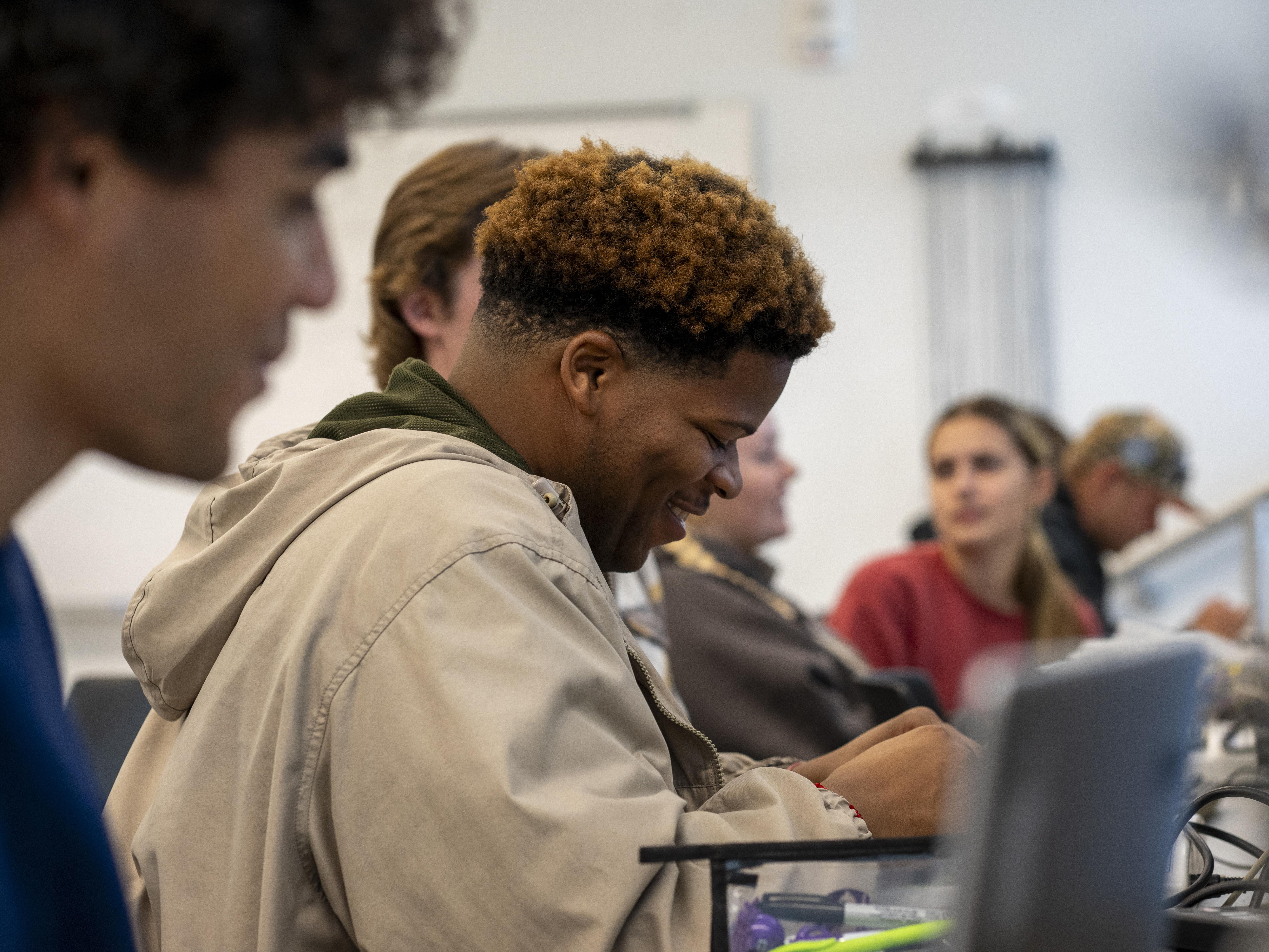
SUNY Oswego’s new School of Engineering and Natural Sciences collects some of Oswego’s signature and strongest programs with a lens on collaborating and focusing on growing job opportunities.
Announced in summer 2025 as part of SUNY Oswego renaming and re-envisioning Oswego’s four colleges, the renamed College of Liberal Arts, Sciences and Engineering (CLASE) became three new schools: the School of Engineering and Natural Sciences; School of Humanities; and School of Social and Behavioral Sciences.
“We have great strengths in engineering and natural sciences,” said Kristin Croyle, dean of CLASE. “We draw from all over the state and outside of the state in many of these programs.”
The School of Engineering and Natural Sciences, with Marianne Hromalik of the Electrical and Computer Engineering Department as director, includes the departments of:
- Atmospheric and Geological Sciences
- Biological Sciences
- Chemistry
- Computer Science
- Electrical and Computer Engineering
- Mathematics
- Physics and Astronomy
Working together and realizing that research doesn’t necessarily fit into one box or category means that the majors and classes often complement each other, Croyle noted.
Oswego’s reputation for outstanding undergraduate research opportunities and faculty mentors comes even more to the forefront when speaking about the new school while showcasing these strengths, Hromalik noted.
“Because we are primarily an undergraduate institution, we have very friendly faculty and close relationships between faculty and students,” Hromalik said. “Our faculty know their students well and interact with them. Some people see science as a colder, less friendly field but it’s certainly not that way with us. We should never lose that personal touch.”
“Our faculty are really exceptional and our students get opportunities at Oswego to work with research they won’t get anywhere else,” Croyle noted. “One thing that continues to distinguish us is that we offer more high-quality academic experiences than many undergraduate institutions.”
Hromalik knows that future students want to hear most from current Oswego students and the college is developing a kind of STEM ambassador program.
“We hope to get students from every department as outreach officers, knowing high school students respond better to our students,” Hromalik said. “We can train our students for these roles and they enjoy talking about their experiences, meeting students for tours, working open houses and attending events that we have.”
Collaborating and elevating
Hromalik is working with the directors of CLASE’s two other schools –- Candis Haak of the School of Humanities and Alanna Ossa of the School of Social and Behavioral Sciences –- on ways they can not only collaborate but elevate opportunities and student experiences.
“We’re seeing a lot more collaboration, as we meet with the other directors all the time and share what we learn,” Hromalik said. “We learn from each other in terms of how we view recruitment outreach and student success strategies. It really has been amazing, actually very eye-opening.”
“In addition, there can be more that they can accomplish to bring in community members and serve our students,” Croyle said.
The university’s community-oriented programming around the 2025 total solar eclipse was a “great example of what engineering and natural sciences programs can do together,” Croyle said. “The faculty brought that all together. Creating this school allows them to do more of this kind of work.”
“People don’t tend to be isolated once they work after graduating, so it’s good to get people to work together, get up and speak, design your workflow and that kind of thing,” Hromalik said. “I think it actually helps to see these different points of view, so people aren’t living in a bubble. We also discover how much common ground there is.”
A recent example of working across teams involves two electrical and computer engineering students –- Spencer Evans and Tom Mendelis –- designing and constructing a miniature submersible craft (essentially a mini-submarine) at the request of Nicholas Sard of biological sciences with his research on species and environmental factors in Lake Ontario and its watersheds.
The research project already shows connections with other disciplines beyond biological sciences such as chemistry, physics and technology education as it unfolds, with a full test run scheduled by the end of the semester before passing to another group of students to continue development in future semesters.
Evans and Mendelis said the hands-on learning experience has taught them about many aspects of engineering and what it’s like to work for a client –- which have been valuable lessons.
“Something you don't realize at first is as an engineer is you have to design for the manufacturing process and for other people’s needs,” Evans said. “So there has to be a lot of communication to make sure you don't drift away from their project goals and you learn and experiment along the way.”
“We have a lake that is a big deal,” Hromalik said. “In the sciences, there is a huge amount of work associated with that lake, and a lot of projects we can make really great use of our location.”
Working from an idea originally from Ossa, Hromalik looks forward to showcasing the impact the lake has on research with a Maritime Symposium during Quest, the annual celebration of scholarly and creative activities, on April 22.
The symposium would look at work across the natural and social sciences, business, education, the arts and more. The launch of the university’s Great Lakes Institute and the recent designation of the Lake Ontario National Marine Sanctuary in the adjacent waters boost opportunities.
“For us, Lake Ontario is an example of what makes us special,” Hromalik noted.
Engineering opportunities
Rising opportunities and demand for engineers drove the addition of the “E” that turned “CLAS” into “CLASE” and its spotlight among the natural sciences in the new college.
SUNY Oswego’s ongoing collaboration with Micron Technology –- which is building a microchip fabrication plant in Clay just across the Oswego County line and promising to invest $100 billion into Central New York in the next 20 years –- have placed additional focus on what is “always a hot job field,” Croyle said.
“We have a huge demand for engineering,” Hromalik said. “Most of our engineering students have jobs lined up before they graduate, especially if they are proactive. It’s a very hot field and starting salaries are great. It’s countrywide and even before Micron there was a need, but it’s even bigger now.”
Hromalik added that Oswego presents a great value, as engineers can get the same job and same pay as others attending private schools and racking up higher debt.
“Our engineering programs were created to make an affordable option,” Hromalik said. “A lot of our industry partners lobbied for our program. And we still work with many of them, whether on the Engineering Advisory Board, during Engineering Week, partnering on internships or other avenues.”
Again sponsored by Micron, this year’s Engineering Week runs April 6 to 10 and will again feature an alumni panel, a women in engineering panel and an industry showcase that also serves as a job and graduate school fair. New this year are an Innovators Showcase with high school students in a partnership with CiTi BOCES and a tour of National Grid.
Hromalik noted that some partners, especially engineering alumni, enjoy coming to classes and career-focused activities. Establishing Oswego as a viable pipeline that provides academic quality and great value will only continue to expand opportunities.
Projects under discussion could include connecting with local schools and high-school students for campus activities or even coursework to help them get a jump on the opportunities.
But Hromalik emphasized that engineering is just one of the successful programs in the sciences that provide research opportunities and career pathways for current and future Lakers.
“Our faculty, current students and alumni all can speak to how great all our science programs are,” Hromalik said. “The new school just recognizes how well we work together while providing an outstanding value.”