




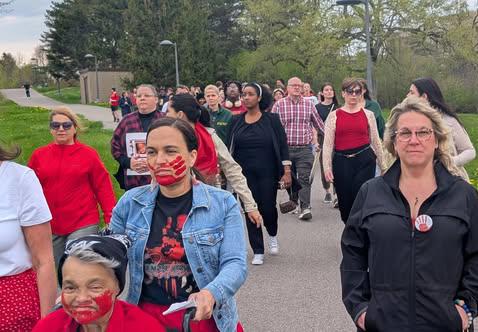
On Tuesday May 5, students, faculty and staff gathered in recognition of Missing and Murdered Indigenous Women, Girls, and Two-Spirit people — often referred to as MMIW.
This day is also known as Red Dress Day, a powerful movement that began in Canada and has spread across North America. Empty red dresses hang in public spaces to serve as a visual reminder of those who are missing, those who have been taken and those whose stories are too often left unheard.
This installation of red dresses was created by students in the SUNY Oswego Department of Theatre as part of THT 315: "Costume Design." In an assignment that integrates culture, diversity and global awareness, students were asked to research and immerse themselves in Indigenous historical and contemporary fashion as well as cultural practices.
Alongside this research, students studied the MMIW movement and heard from individuals with personal and community connections to this ongoing crisis. Applying their cultural and historical research to their costume design learning, each student designed and draped a dress specifically for this installation.
The work represents a merging of design practice and cultural awareness, where the process of making becomes a form of witnessing, learning and honoring. This installation stands in solidarity with Indigenous communities and the international Red Dress movement, using the language of clothing and visual storytelling to bring attention, presence, and remembrance into shared space, organizers said.
Statistics show that Indigenous women face disproportionately high rates of violence, and that in the United States, Native women are murdered at rates far higher than the national average, and many cases of missing persons go unsolved or unreported. Organizers said that these realities are not accidental — they are rooted in a long history of systemic inequities, jurisdictional challenges, underfunding of services and the ongoing impacts of colonization.
In an event that the Native American studies program helped organize, the day was about honoring lives, amplifying voices and demanding change by education, learning the history that is often left out of textbooks, listening to Indigenous voices and recognizing the resilience and strength of Indigenous communities.
Organizers noted that doing so also means challenging the systems that allow this crisis to persist. Advocacy can take many forms: supporting policies that improve data collection and law enforcement coordination, amplifying Indigenous-led organizations and ensuring that survivors and families have access to the resources they need.
Equally important, organizers add, is how people show up in their daily lives — in the conversations they have, the respect they show for Indigenous cultures and the commitment they make to stand in solidarity, not just on Red Dress Day, but every day.
The red dresses people see are empty, but they are not silent, organizers said, as they call on the community to remember, care and — most importantly — to act: Honoring those who are missing and those who have been taken by refusing to let their stories be forgotten. Organizers encourage the campus and community to commit to building a future where Indigenous women, girls and Two-Spirit people are safe, valued and protected.