


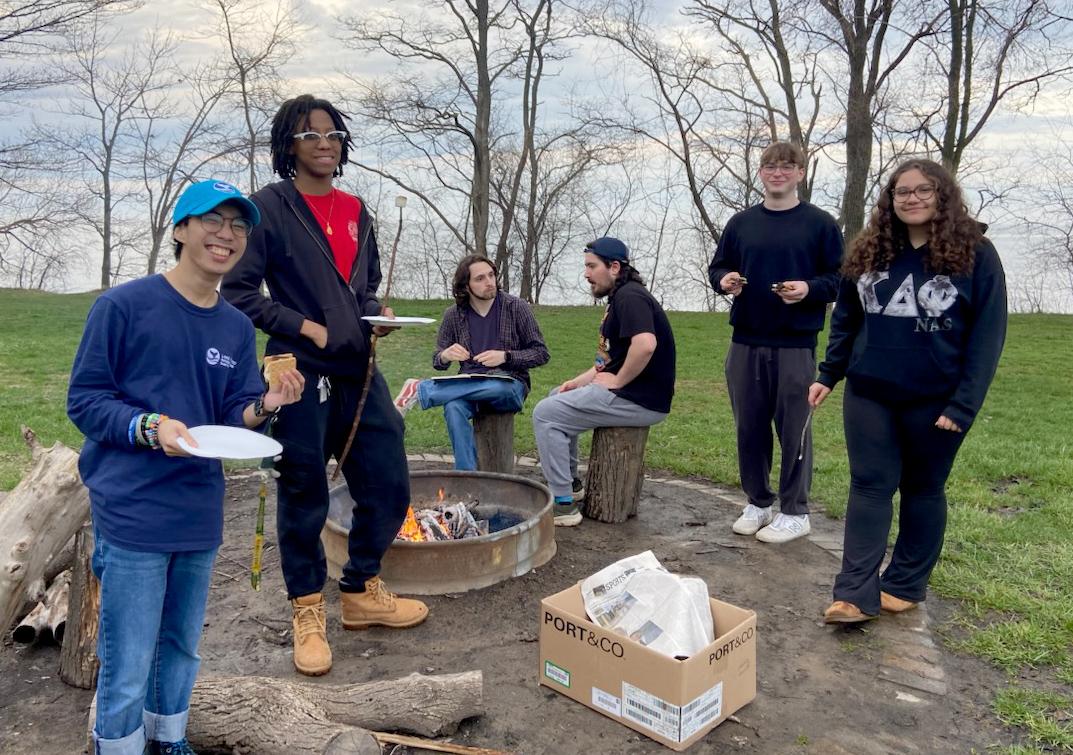
Great Lakes Institute interns and student volunteers with the Shining Waters lakeshore cleanup pause during a post-pickup bonfire as part of Earth Month activities.
The Great Lakes Institute (GLI) at SUNY Oswego proudly celebrated Earth Month alongside partners and friends from across campus, community and region.
Recognizing that every day is Earth Day and that the responsibility of stewardship needs to be constantly reaffirmed, GLI supported collaborative efforts across a diverse array of fields in academic research, creative work and community stakeholder engagement. This work is made even more special due to the university’s unique location right on the shores of Lake Ontario, allowing for an intimate connection to its coastal environments.
Great Lakes Institute Director Lisa Glidden, also a professor of politics and interdisciplinary studies, as well as student interns Tammi Kallahan, Georgia Mosier and Bryan Santiago, actively represented the university as ambassadors at various local and regional events, with more on the horizon.
April and late March were a busy few weeks for the institute, which is celebrating its second anniversary since its establishment in 2024.
A month making waves
An exciting spring season really began with the inaugual Salmon Celebration interdisciplinary showcase in the Hewitt Hall Ballroom. Organized by cinema and screen studies professor Tiffany Deater and Stacy Furgal, New York Sea Grant fisheries and ecosystems extension specialist, the event brought together numerous campus offices and departments, original student artwork and indigenous storytelling from Perry Ground (Onondaga Nation, Turtle Clan) in celebration of the humble and somewhat native fish species.
That momentum continued with a guest speaker invitation for Glidden and Santiago to speak to the Rotary Club of Oswego about shipwrecks, maritime archeology and the political management and relationships around the cross-border lake.
That same week, Glidden and Santiago represented SUNY Oswego at the quarterly National Oceanic and Atmospheric Adminsitration's Lake Ontario National Marine Sanctuary Advisory Council meeting. Glidden serves as the research, science and technology representative member on the council. Glidden and Santiago then attended the inaugural Lake Ontario International Film Festival.
The Great Lakes Institute interns collaborated with Shining Waters and the Office of Sustainability for a shoreline cleanup and interpretive bonfire program. Student involvement and participation included interns Kallahan and Mosier showing off their knowledge of local geology and biology as students hiked on the lakeshore for the cleanup, along with the popularity of their free stickers.
GLI concluded Quest day on April 22 with an evening multidisciplinary panel featuring presentations on Oswego’s maritime history by Michael Pittavino of the H. Lee White Maritime Museum, poetry by Laura Donnelly, local archaeology by Alanna Ossa, the Lake Ontario fishery by Furgal, and electrical and computer engineering students Spencer Evans and Tom Mendelis discussing their hands-on research into building a semi-autonomous submersible craft that will study lake-bed environments up close.
To close out a busy and exciting Earth Month, the Great Lakes Institute and SUNY Oswego served as the host institution for the 2026 Lake Ontario National Marine Sanctuary Remotely Operated Vehicle (ROV) educators’ workshop, hosted by the Marine Technology Society (MTS) and its MATE ROV Competition program and by staff from NOAA and the National Marine Sanctuary Foundation.
More than just an underwater robotics competition, MATE ROV educates students on the workforce skills needed in the marine technology sector, a core component of the emerging and innovative "Blue Economy." Supported by a grant from the National Marine Sanctuary Foundation and its Sanctuary Community Fund, Jody Patterson of MTS/MATE ROV and Daniel Moffatt of NOAA Thunder Bay National Marine Sanctuary in Michigan led more than 20 educators from across New York state — many from Lake Ontario National Marine Sanctuary communities — in building a basic ROV out of PVC pipes, circuit boards, motors with propellers and pool noodles, then testing them out in a pool.
All educators were able to take their kits home, each valued at more than $300, to demonstrate and rebuild with their middle and high school students during the school year -- students who may one day join a competitive MATE ROV underwater robotics team. ROVs can go to locations in large bodies of water where it is either impossible or unsafe to deploy human divers, such as to study shipwrecks as submerged archeological sites.
Local educators, in particular from CiTi BOCES and Oswego High School, took part in the two-day weekend intensive course hosted in the Shineman Center and Lee Hall. CiTi BOCES, through their collaboration in the P-TECH (Pathways to Technology in Early College High School) program at SUNY Onondaga Community College, and Oswego High School both received grants from the National Marine Sanctuary Foundation to establish or expand an ROV development program for students.
Summer activities on the horizon
In spring 2025, SUNY Oswego’s Great Lakes Institute a $100,000 grant from the National Marine Sanctuary Foundation's Sanctuary Community Fund to support community outreach through three ongoing student internships, tabling, guest speaking, events and — more importantly — by hosting K-12 students with on-campus programming. These students and classes come from across the four counties of the Lake Ontario National Marine Sanctuary and more broadly from across Central New York and the North Country.
The National Marine Sanctuary Foundation supports the work of NOAA’s Office of National Marine Sanctuaries and the national marine sanctuary system (essentially underwater national parks), and the Sanctuary Community Fund is a mechanism that, according to its mission, “invests directly in community partner engagement so that the heart of sanctuaries –- the peoples, places, customs and cultures –- can help advance science and ways of knowing, stewardship and outreach within the sanctuary community and beyond.”
The Great Lakes Institute will host students from Baldwinsville, Fulton, Oswego and Watertown in May and June for field trips on SUNY Oswego’s main campus and at the university's Rice Creek Field Station. Glidden and the three student interns will be supported by a team of faculty, volunteers and interpretive staff in executing the trips.
The Institute is also continuing its outreach work, with a return to the Rotary Club in late May, and tabling at the Lake Ontario Waterfront Festival in early June. They also hope that alumni who return for Reunion Weekend will explore the beautiful protected waters of the marine sanctuary and spread word about this work with their friends, family and others.
While there are no future internships planned, Glidden encourages interested students to get in touch, get involved with other local partners, to provide curricular resources and to create more meaningful opportunities for supporting Lake Ontario and the Great Lakes. There are paid internships available with New York Sea Grant and the H. Lee White Maritime Museum, while recreational organizations such as the Sailing Club, Outdoors Club and Fishing Club are always looking for new members.
For more information on the Great Lakes Institute, visit the institute's website.
-- Submitted by the Great Lakes Institute