




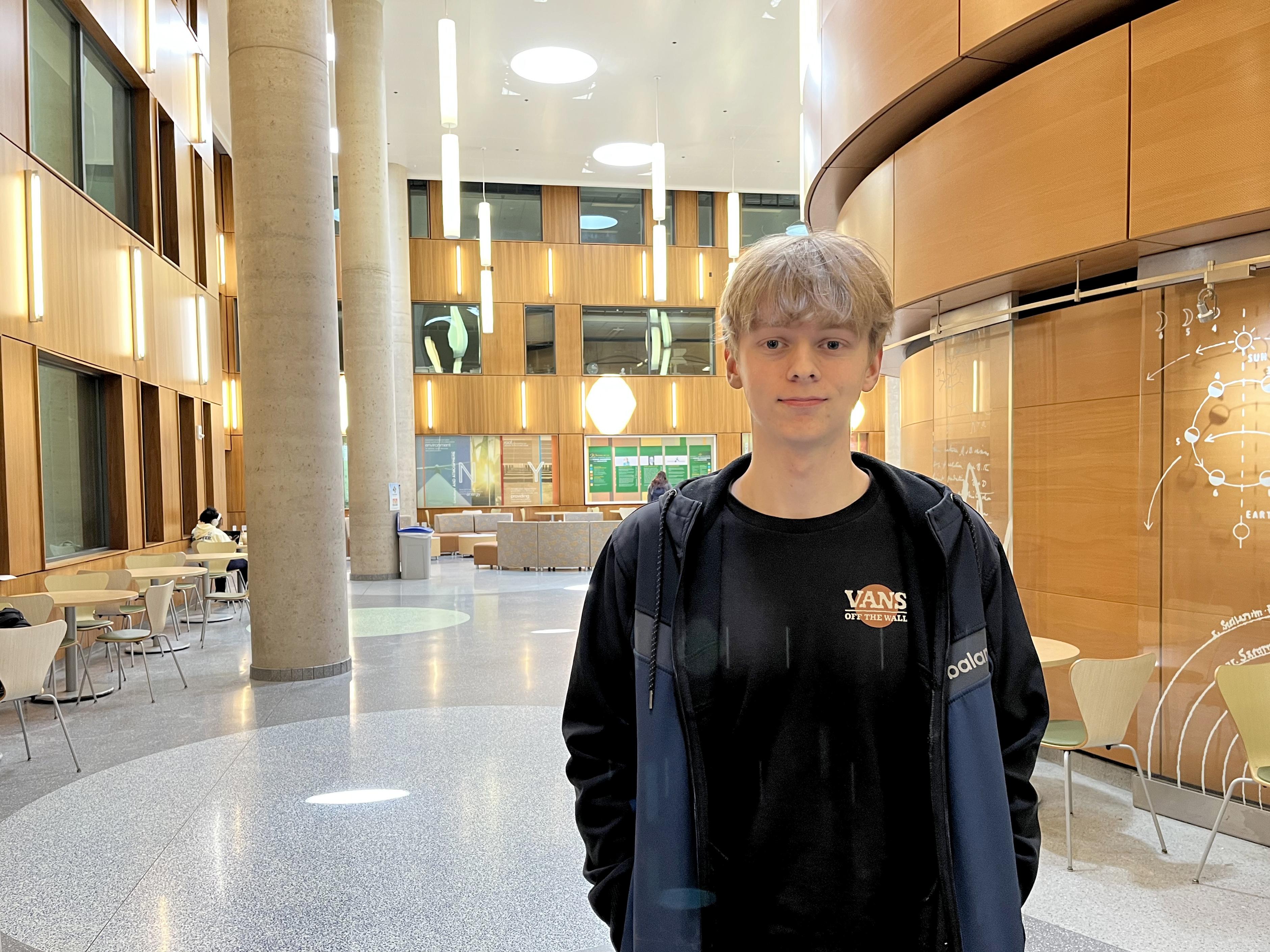
Among participants in SUNY Oswego's May 16 Commencement ceremonies, Noel Brathen practically completed a speed run to get there, graduating early with a bachelor’s in computer science and minor in mathematics at 19 years old.
Preparing to next enter Georgia Tech’s highly ranked master of science in computer science program, Brathen had a head start before even becoming a Laker. Brathen earned 50 credits to transfer in due to working hard in high school, also graduating as the salutatorian at nearby Red Creek.
“The biggest thing I did was take college credits seriously in high school, both AP courses and dual enrollment classes,” Brathen said, which made it possible to start computer science coursework quickly. “I'd known for a while that I wanted to study CS, so I was deliberate about choosing classes that would either count toward a degree or build the math and programming foundations I'd need.”
Brathen also took advantage of Oswego’s summer class schedule to get ahead of the curve.
“After my first two semesters at Oswego, I took two summer classes: a biology class to satisfy my cognate science requirement and a CS elective,” Brathen recalled. “Summer classes are condensed and intense, which honestly fits how I prefer to learn. You're fully immersed in the material instead of juggling it alongside three or four other courses.”
Brathen’s time included some standout courses, with CSC 322 (“Systems Programming”) taught by Jae Woong Lee perhaps the favorite.
“I love working with low-level systems, understanding how the computer actually executes code, how memory and processes work under the hood and everything we use today was built,” Brathen said. “That's the area I'll be focusing on in graduate school too, so the class confirmed I was heading in the right direction.”
Astronomical achievements
Brathen also particularly appreciated CSC 380 (“Software Engineering”), taught by James Early, which allowed an opportunity to work with a Distinguished Professor of Physics and Astronomy Shashi Kanbur and visiting scholar Kamal Jabbour at Rice Creek Field Station.
The hands-on learning opportunity was “a real project, building a machine learning program that detects satellite trails in astronomical images and removes them, so astronomers can work with cleaner data,” Brathen said. “Oswego's CS faculty are accessible in a really valuable way. You can drop by office hours, ask questions and get good answers.”
Looking back on the time in Oswego, Brathen knows that the degree set a path for a successful future.
“Oswego gave me strong fundamentals, solid coursework in algorithms, systems, networks, software engineering and the math that lies under all of it,” Brathen said. “But the bigger thing was probably learning how to learn at the college level. Grad school is going to demand a lot of independent reading and self-directed problem-solving. Oswego's CS program helped me build those habits, especially in the upper-level classes where you're expected to learn more material on your own.”
For people looking to complete their degree on a tight timeline or early to save on time and expenses, Brathen had advice for those in high school or early college considering such a path.
“Figure out what you actually want to do as early as you can,” Brathen said. “Acceleration only helps if you're going somewhere specific. If you don't know yet, take a wider sample of classes before committing.”
Finishing early, Brathen said, is less important than getting an experience that will properly prepare you to succeed.
“Don't focus too hard on finishing early. The real goal is getting to the interesting work sooner, not getting a diploma faster,” Brathen said. “Take hard classes. The temptation when you're trying to keep your GPA up or graduate quickly is to pick the easier path, but the hard classes are where you actually grow. Finally, use your summers. Three months is enough time to take a class, build a project or learn a new tool.”