



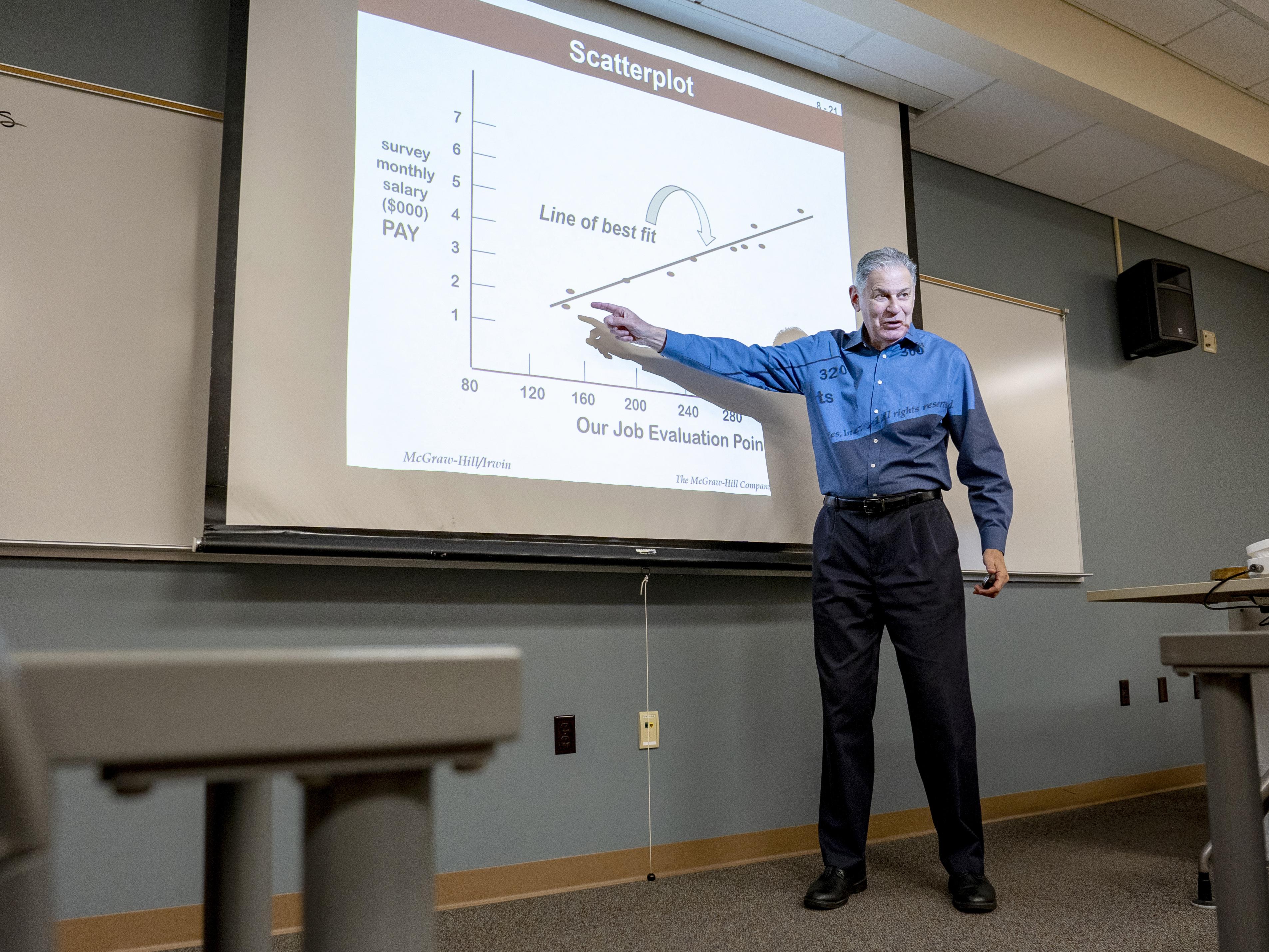
Shown teaching a class in Rich Hall, College of Business and Entrepreneurship faculty member Barry Friedman recently co-authored an international article looking at factors behind social media success among digital entrepreneurs.
With the rise of entrepreneurship, social media marketing and globalization, College of Business and Entrepreneurship faculty member Barry Friedman’s research on these key topics includes co-authoring an article with international partners that examines data and offers tips to those trying to thrive in business.
“Exploring the Impact of Social Media Usage Frequency, Prior Knowledge and Online Social Capital on Opportunity Recognition” in the Eurasian Journal of Business and Economics also featured co-authors Nergis Aziz, a past visiting scholar at Oswego and now a social media specialist in Istanbul; Derya Dogan of Boğaziçi Üniversitesi in Türkiye and a digital entrepreneur; Zhanar Dyussembekova of Narxoz University in Kazakhstan; and SUNY Oswego alumnus Ryan Dadey, a director for KPMG LLP in New York.
“This latest research studied how digital entrepreneurs identify business opportunities using social media in developed and developing countries (United States and Kazakhstan),” Friedman said.
Online social capital –- or building large, trusted and high-quality networks through effort, experience and positive actions –- was the most consistent indicator of success.
“The larger your online social capital, the bigger your database becomes in which to identify opportunities,” Friedman said. “We tell our students that among the best ways to identify employment opportunities is to build a large and relevant network. The same is true of entrepreneurs.”
The rise of entrepreneurship worldwide and the importance of social media marketing to success make the research important to the field, Friedman said.
“The Global Entrepreneurial Monitor (GEM) found record-breaking entrepreneurial growth in the U.S.,” 18 percent among women and 20 percent among men, Friedman noted.
“Having worked predominantly for large corporations with waves of layoffs that continue to this day, entrepreneurship emerged as a viable road to the American dream,” Friedman said. “This trend is international in scope, and while globalization is somewhat diminished in the short term, the long-term remains promising.”
Applicable to students
The results are applicable to the world at large and SUNY Oswego students alike as “many of our students aspire to be entrepreneurs,” Friedman noted, adding this was an impetus to the university’s former School of Business evolving into the College of Business and Entrepreneurship.
Quality is more important than quantity in social media activities, findings suggest.
“We found that social media usage frequency wasn't associated with identifying business opportunities in either country,” Friedman said. “Bigger isn't better; the quality of one's network in terms of access to funding, knowledge and information” is more important.
The study also found that the "hedonic value" -- or how much fun and enjoyment is involved -- tends to increase social media participation.
The research involved survey data from 264 digital entrepreneurs –- 177 in the United States and 87 in Kazakhstan –- while also collecting data via social media platforms, with subsequent analysis from its range of expert contributors.
“Our findings are applicable to our students who aspire to be entrepreneurs and those already in the field looking to build a business,” Friedman said. “Since one doesn't know what they don't know, identifying business opportunities is a critical skill using advanced tools like AI and social media in general.”
While these findings will be helpful, they represent just one milestone in ongoing research into this key business activity.
“Opportunity recognition is only a first step –- utilizing your network to develop and grow a business is worthy of study,” Friedman said. “I also want to continue research on what drives entrepreneurs –- that is entrepreneurial motivation.”
Being able to include Dadey -- who earned both a master of business administration in 2017 and a bachelor's degree in 2014 from SUNY Oswego -- was an additional rewarding aspect of the research, especially as the alumnus remains interested in working with Friedman and Aziz in exploring topics.
International experience
Before coming to SUNY Oswego, Friedman built a career at global corporation ExxonMobil, which included a lot of international business, generally in Europe.
When he joined SUNY Oswego, Friedman “was still very motivated by international assignments” and happy when then-dean Richard Skolnik connected him to teaching in Singapore. “Since then, I've taught in Germany, China and Japan,” Friedman said.
“The other opportunity to satisfy my desire to be exposed to other cultures presented itself when Dr. Nergis Aziz, a Turkish scholar, was a School of Business (now COBE) visiting scholar beginning in 2011,” Friedman said. “Twelve publications later, we are still collaborating on research that addresses comparative international entrepreneurship motivation and practices.”
Friedman also has received multiple Fulbright Scholarships –- two to Germany –- and published with German academics.
All of this international research and collaboration contribute to what he is able to bring to SUNY Oswego students and a university that presents an outstanding value to those coming for a degree.
“In alignment with our mission, COBE is effectively building an infrastructure to live up to its name change,” Friedman said. “This includes an entrepreneurship minor, specific courses that address entrepreneurship, Launch It student entrepreneur competition, experiential learning and hands-on experiences running a small business such as our student-run Rich N’ Pour cafe.”
Beyond that, COBE and its faculty are committed to expanding international experience for students.
“Many of our faculty have led study-abroad opportunities to enrich our students' international awareness,” he said. “Every time you go abroad, you bring something back –- especially for those who don’t have the ability to travel abroad.”
But ultimately, this research and other faculty activities support preparing SUNY Oswego student entrepreneurs and other business majors for the future.
“We have courses and outside-the-classroom experiences that develop our students' ability to excel in this entrepreneurial marketplace,” Friedman said.