



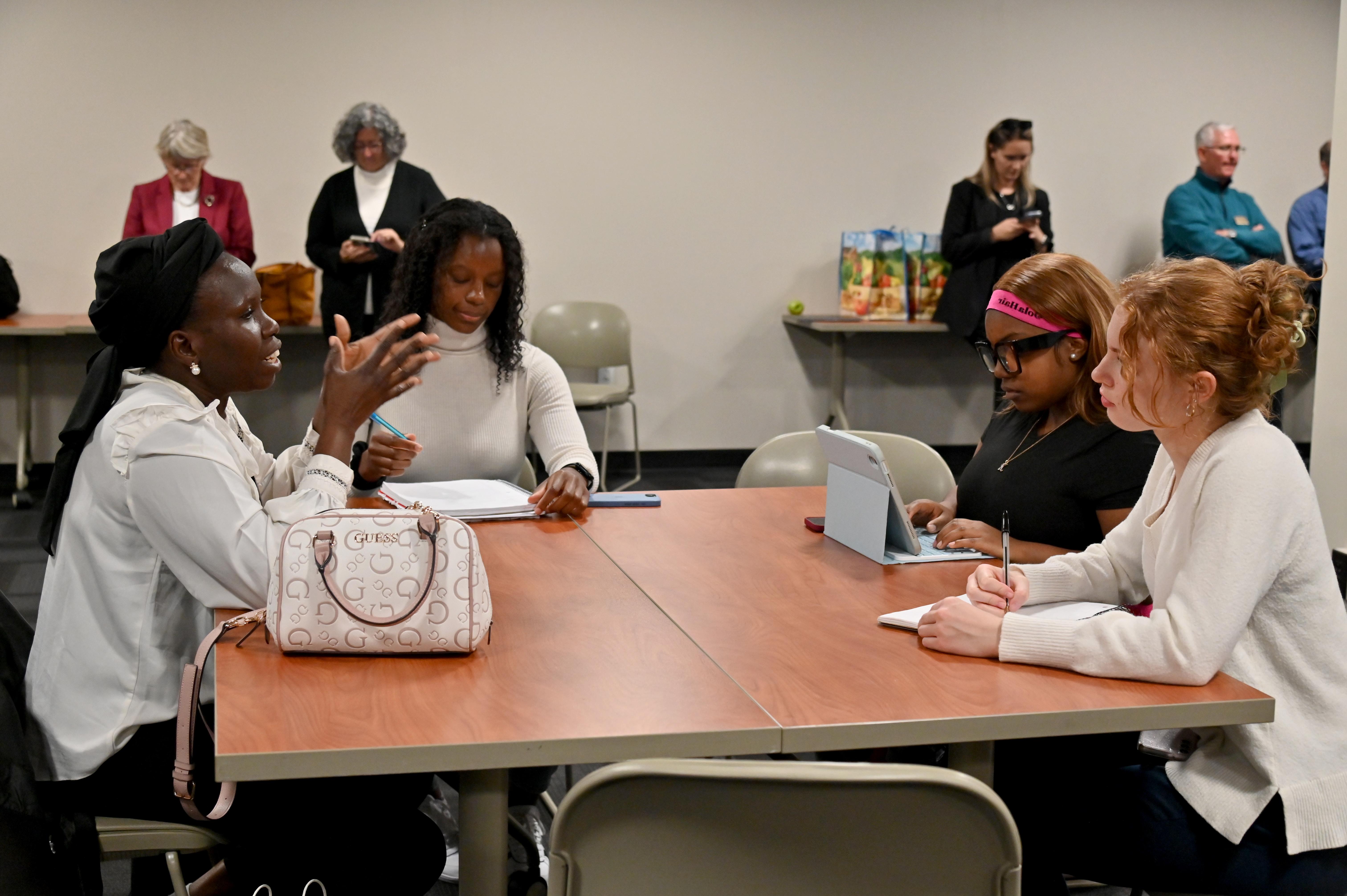
Earlier this semester, representatives of the Humphrey Fellows program visited with members of SUNY Oswego's "Cultural Environment of International Business" class to boost student knowledge and research projects. From left are Humphreys Fellow Ramatoulaye Toure of Senegal with students Maggie Pifer, Kamaia Bexley and Megan Wolf.
A SUNY Oswego intercultural management course draws on the rich backgrounds of visitors from the Hubert H. Humphrey Fellowship program and opportunities to learn how to do business and interact with others from around the world.
The “Cultural Environment of International Business” course, taught by Paul Babiarz, aims to prepare students to work in an increasingly globalized economy, and by hosting distinguished guests from a dozen countries in class, which feeds a research project, allows real-world opportunities for learning and connections.
"The class explores various cultures and develops appropriate ways to present themselves when engaging with individuals from those cultures," Babiarz explained. “They explore questions like ‘how do I act?’ ‘how do I greet people?’ and ‘what should I talk about?’”
If the students hope to do business on an international scale, knowing what to do not only avoids embarrassment but paves the way for quicker acceptance from others, which the MGT 469 class and key project look to support. The class and its content complement Oswego's College of Business and Entrepreneurship's goals to prepare well-rounded, informed and globally aware graduates.
On Oct. 16, the Humphrey Fellows, who spend 10 months in the area hosted by Syracuse University, came to Oswego to meet with the 31 members of the class, who work in groups.
Babiarz offered a lot of praise for the Humphrey Fellows program –- sponsored by the U.S. Department of State and administered by the Institute for International Education –- and the fellows in the Syracuse cohort, who are remarkable individuals and rising stars in their own country. This year’s fellows hosted by Syracuse represented Armenia, Brazil, Ghana, Kosovo, Pakistan, Republic of Korea, Republic of Türkiye, Senegal, South Africa, Uruguay and Uzbekistan.
“They are very generous with their time and knowledge,” Babiarz said.
“Our students are assigned a country for their research project and they have an opportunity to speak in depth with a fellow or fellows from that country,” Babiarz said. “While the students do research in advance, they learn a lot and it’s very engaging.”
After the class presentations on each country wrap up, the experience culminated with a reception Nov. 20 at SUNY Oswego’s Syracuse Campus with the Humphrey Fellows, MGT 469 students, President Peter O. Nwosu and other guests. SUNY Oswego's Office of International Education and Programs also helps coordinate opportunities for interaction.
“The fellows present five-minute presentations on some facet of their country,” Babiarz said. “It’s educational and entertaining.”
Lessons learned
In the Nov. 11 edition of the class, students Kamaia Bexley, Maggie Pifer and Megan Wolf presented on the African nation of Senegal, bolstered by their conversation with Senegal scholar and fellow Ramatoulaye Toure and their additional research.
Senegal is a peaceful country with a very youthful population still very family-based. They are generous in sharing with others and combine holidays and others traditions of a majority Muslim nation with those of its Christian population.
The students said that, for the Senegalese, relationship-building before doing business is preferred, as they prefer to get to know and trust business partners. Expect to socialize and take your time before accomplishing anything related to business, students said. Present business cards with either both hands or your right hand, and make sure at least one side of the card is printed in French, the dominant language of the country.
The class noted that, whether in Senegal or any other nation, following the lead of the hosts in terms of behavior, greetings and relationships, is always a wise move.
“I was very unfamiliar with Senegal before doing this research project so pretty much everything I learned was new and interesting,” said Wolf, a business administration major. “I think the piece that stood out the most was that they are very welcoming to tourists and visitors and a very hospitable country.”
“Being in the business field, I am going to encounter peers who are from different countries and peers who do things differently than in America,” said Bexley, a business administration major. “I am fully prepared to learn about the do's and don'ts of international business. Some things that are accepted here may not be accepted there, and I have to prepare myself for those encounters.”
“Our research on Senegal and conversations with our Humphrey Fellows helped me understand how different business is globally,” said Pifer, a human resource management major. “I think it's good to learn how to do business in other countries, especially if you want to be a manager. A lot of companies go global.”
“The research we did was meant to build on pretty much every concept we learned throughout the course,” said Wolf, noting the project ”was really interesting because you could really get a good look at how these things are present in everyday life and how you can use them yourself outside of the U.S. It gave us insight to how other countries lived and how different it is from here, things I don't even notice being a part of life here that I would have to relearn in order to travel.”
“It helped me learn about the cultural environment by providing real-world case studies of cultural dynamics in business,” Pifer said of the class. “The course covered things like cultural frameworks, communication and ethics which gave me an idea on how to make good decisions, especially internationally. The course helped with skills like negotiation techniques and collaborating with people from different backgrounds to achieve goals.”
“This research has enhanced my understanding of how the world is different in terms of its cultural and social aspects,” Bexley noted. “I was able to see, from another person's perspective, how they live their lives. Also, I view life differently, which makes me want to get more engaged in traveling the world and seeing what's out there beyond the States.”