


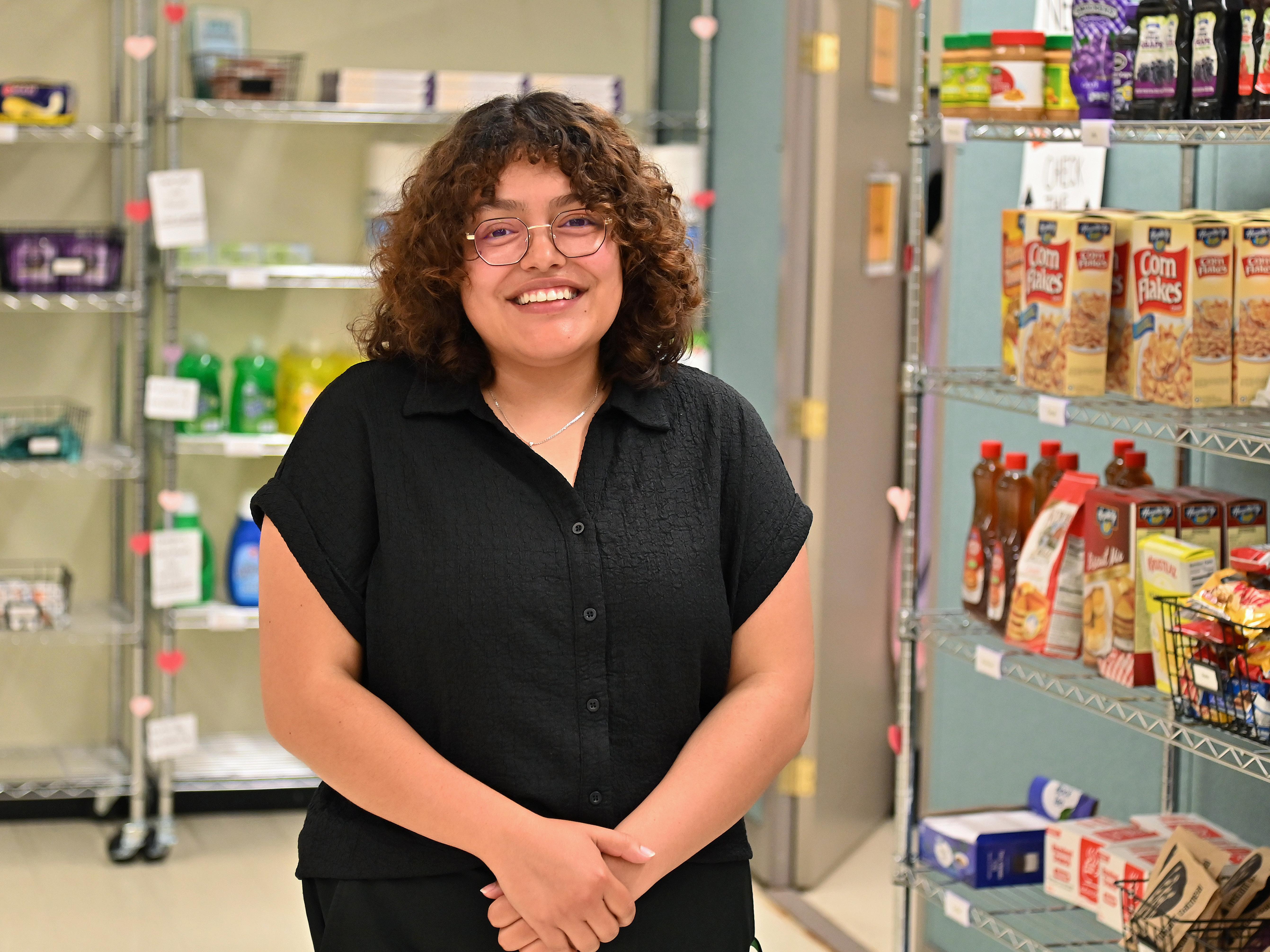
April Lopez, assistant dean of students and SUNY Oswego’s basic needs case manager, manages SHOP — Students Helping Oz Peers -- that helps students in need of food, winter clothing, toiletries, professional attire and more.
One simple question — “Do you have a winter coat?” — made sure a student didn’t have to face winter without one.
For April Lopez, assistant dean of students and SUNY Oswego’s basic needs case manager, that exchange captures how SHOP — Students Helping Oz Peers — has grown into one of the university’s most essential resources.
SHOP, which began as a student project in 2016 and was the first of its kind in the SUNY system, has become a program sustained by collaboration, student involvement and, increasingly, alumni support.
By providing free food, clothing, hygiene supplies and professional attire to hundreds of students each semester, SHOP helps ensure that basic needs do not stand in the way of academic success.
“I oversee the shop in the pantry, but also kind of work on other food-related resources for students and the technology resources as part of a broader initiative to support student basic needs,” Lopez said.
Lopez said her commitment to SHOP is rooted in both professional experience and personal connection. Before coming to SUNY Oswego in 2024, she ran a food pantry at Iowa State University and studied food systems in graduate school.
“And as someone with personal lived experience of food insecurity, and then dedicating a whole master’s to studying it, I just really care about ensuring that students who may not always have access or readily available access to resources that they need, especially when it comes to food,” Lopez said.
She emphasized the importance of reducing stigma around seeking help.
“I want to push or make a push towards trying to destigmatize and normalize seeking assistance,” Lopez said. “I want them to know that these resources are here for them.”
Growing to meet needs
Since joining Oswego, Lopez has overseen significant changes to SHOP’s operations and space. Originally housed in the health center, the pantry moved to Penfield Library as demand grew. Old bookshelves were replaced with pantry shelving, inventory systems were improved and staffing expanded to include professional staff, graduate assistants, interns and volunteers.
“My role was the first professional staff to be able to oversee it,” Lopez said.
With increased staffing capacity, SHOP has expanded its hours, offerings and outreach efforts. This included launching a SHOP outlet in SUNY Oswego's Syracuse Campus in February 2025.
The pantry now receives food from the regional food bank every two weeks and incorporates student feedback to better serve different populations, including international students.
For senior Avery David, a SHOP operations intern and human development major, the work is both hands-on and meaningful.
“As a SHOP intern, I help maintain the pantry space, check out students, restock shelves, sort donations and manage our inventory system,” David said. “I also assist with tabling events and pop-up shops.”
David said he joined SHOP not only for internship experience, but because the mission aligns with his academic and career goals.
“Human development is about understanding how people grow and how to support them,” he said. “SHOP allows me to do that in a real, tangible way.”
Working at SHOP has reshaped how David views campus life.
“It opened my eyes to how many students struggle with food insecurity,” he said. “It made me see campus more empathetically.”
He recalled helping a student who rushed into the pantry before a job interview, worried they had nothing appropriate to wear.
“I was able to point that student in the right direction so that they can get the proper attire they needed for their interview,” David said.
He said SHOP helps relieve the stress off of students who are unable to afford basic necessities and provides them with a judgement-free environment where they can feel supported.
Powered by alumni generosity
David said alumni support directly affects what the pantry can offer.
“Their support helps to keep the pantry stocked and flowing,” he said.
With additional funding, he said, SHOP could expand its hours, increase food selection and host more outreach events.
Part of SHOP’s mission extends beyond food access. Lopez said the Professional Attire Fund plays a key role in helping students feel prepared for interviews, internships and career opportunities.
“It can mean a student walks into an interview confident instead of stressed,” Lopez said.
SHOP’s budget relies entirely on donations, which allow the program to purchase essential items such as detergent and hygiene supplies that are not always available through the food bank.
A few alumni have played particularly transformative roles for SHOP. For example, 1973 alumna Christie Sommers established an endowed fund to support SHOP in perpetuity. During her remarks at the 2025 Scholars Brunch, she shared:
“Because providing shelter, safety, food, and essential needs is care-taking,” Sommers said during remarks at the 2025 Scholars Brunch. “I was drawn to that idea, and it has since become my personal mission … If you see a need, meet that need, and care for one another.”
Another exceptional alumni supporter is 1991 alumnus Steven Messina, a partner at the multinational law firm Skadden Arps and a member of the Oswego Alumni Association Board of Directors.
“He donated $50,000 to SHOP, which made it possible for us to sustain ourselves for the foreseeable future,” Lopez said.
Messina said his support stems from a strong belief in alumni responsibility. A former WTOP-10 TV general manager and meteorology major at Oswego, he said the alumni network played an important role in shaping his college experience.
“It’s a real community,” Messina said. “The alumni network at Oswego is very strong, and we look to support the current students because they’re part of that family, too.”
Messina said learning about the level of need facing students today motivated him to give. His wife, Lori Messina, volunteers with a pantry-and-wardrobe program in New Jersey, which further influenced his perspective.
“I didn’t realize the level of need students face at the university,” Messina said. “There shouldn’t be any SUNY Oswego student who has to worry about where their next meal is coming from.”
Building momentum
Messina said that he believed many alumni would support SHOP if they better understood the issue.
“By giving students the opportunity not to worry about basic needs, they can focus on their studies and their future,” Messina said.
Messina is among those with a goal that no student at SUNY Oswego should go hungry or has to worry about basic needs like food or clothing.
While SHOP has become an integral campus resource, Michael Paestella, director of alumni engagement, is determined to see it expanded.
“When I look at SHOP, I think about how alumni can create a long-term impact here,” he said. “I’ve seen what sustained giving can do. It can transform a resource from something small into something foundational.”
Paestella said the response from some alumni has already been encouraging. During Reunion Weekend last year, several returning alumni brought bags of nonperishable goods after learning more about SHOP’s mission. Alumni are encouraged to donate items or financial resources during Reunion Weekend 2026: June 4 to 7.
“It was really cool to see,” he said. “We had a big move-in bin with the SHOP logo, and alumni immediately understood, ‘Oh, I can help with this.’ I’m hoping this year we can build on that. Education is key.”
Lopez agreed, noting that once alumni understand students’ realities, empathy follows.
“When students feel seen and supported, it changes their trajectory,” she said. “SHOP isn’t just about food or clothing. It’s about dignity, belonging and opportunity.”
“Even small amounts make a difference,” Messina said. “I encourage alumni to participate in giving, especially to programs like SHOP.”
Paestella said expanding SHOP aligns with SUNY Oswego’s broader mission of community care, particularly in a region that faces ongoing nutrition and health challenges.
“Things start small,” he said. “But if we keep educating alumni and building momentum, SHOP can become one of the most supported programs on campus.”
Anybody can support SHOP via this link to help ensure students' basic needs are met.
-- Emily Sosa ’26