




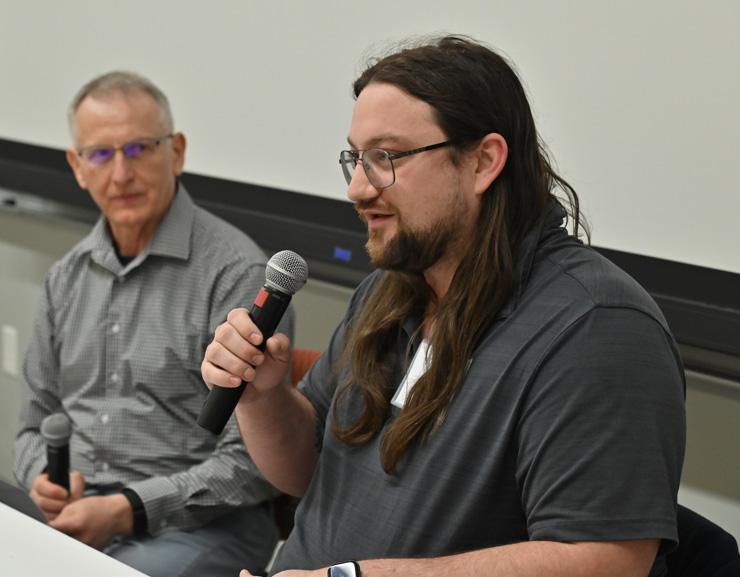
Kenny Roffo, a 2017 SUNY Oswego graduate whose accomplishments since included working on the InSight rover that landed on Mars for NASA, speaks to a full house as electrical and computer engineering faculty member Adrian Ieta looks on.
Engineering Week kicked off Monday, April 6, with a room full of students, eager to hear 2017 graduate Kenny Roffo reflect on his time at SUNY Oswego and the literally out-of-this-world career path that followed his graduation. It was among many events during the week, April 6 to 10, sponsored by Micron Technology.
His presentation took place in Shineman Hall, Room 175 — a space Roffo knew well. He recalled sitting in the same classroom years earlier, listening to a NASA representative, Diane Connor, speak for his class.
To prove he was a strong candidate for NASA, he solved a Rubik’s Cube in front of her in under 15 seconds. A few weeks later, he received a phone call from another representative.
“He was looking for somebody with experience with web development,” said Roffo, who is now a member of the Oswego Alumni Association Board of Directors. “I told him I don’t have that experience but I can build a website tonight.”
After that night, he landed his first co-op internship with NASA, and soon after, Connor offered him his first job opportunity. After earning degrees in computer science, mathematics and physics from Oswego, Roffo stepped into a role as an engineering application software engineer at NASA’s Jet Propulsion Laboratory (JPL) in Pasadena, Calif. — an experience that was as overwhelming as it was exciting.
“When you get into the job for real,” he said, “you’re gonna find there’s a lot of experience that you just don’t have.”
Mission to Mars
At JPL, Roffo worked on a range of high-level projects supporting mission planning and space exploration. One of his most notable accomplishments was his work on the InSight mission from 2017 to 2019, where he contributed directly to operations of the InSight Mars lander. Working alongside two other engineers, he helped develop a custom simulation model and a suite of Python-based tools used for daily operations planning once the spacecraft landed on Mars.
“Holy moly, what an experience,” he said. “It was like, ‘hey, I actually contributed to putting something on another planet.’”
Despite these accomplishments, Roffo admitted the transition wasn’t easy. Surrounded by high-achieving engineers from prestigious and expensive universities, he at first struggled with self-doubt.
“I thought, ‘Who am I to be here?’” he said.
Through persistence and a willingness to learn, that mindset began to shift.
“You’re going to learn a lot from your coworkers,” he explained. “And from just trial and error.”
Roffo emphasized the importance of continuing to build confidence and skills, even when feeling out of place. While working at NASA brought exciting opportunities, it also challenged him to grow beyond his comfort zone.
Learning to lead
Now serving as director of engineering at Fermenta Discovery Inc., Roffo said he feels a greater sense of purpose leading a team and working in a position where others look to him for direction. He leads a small team focused on rapidly prototyping and building new features, balancing speed with thoughtful system design.
“I hold myself to a very high standard,” he explained. “I recognize the gravity of my role and I’m sort of self-composed under pressure all the time.”
He plays a key leadership role in setting engineering standards, mentoring team members and improving internal workflows to make development more efficient. He has focused on designing and implementing a dataset module capable of processing and analyzing millions of records related to individuals and their relationships. He has also built an extensive regression testing suite to ensure reliability as the platform continues to evolve.
He credits SUNY Oswego for helping him reach these opportunities, as well as his own judgment for guiding him in the right direction.
“Trust your judgment and hone your judgment,” he said. “You’re just going to become such a force and it’s going to carry you so far.”
Roffo said the lessons he learned early in his career still guide him today. One of the most important aspects of success, he said, is learning to expect failure.
“Failure is an opportunity to learn,” he said. “Failure is good for you.”
Looking back, his message to students was simple: Trust the process and trust yourself.
“If it’s possible, you can do it,” Roffo said. “We’re all capable of literally anything we can imagine.”
— Written by Emily Sosa of the Class of 2026 for University Advancement