



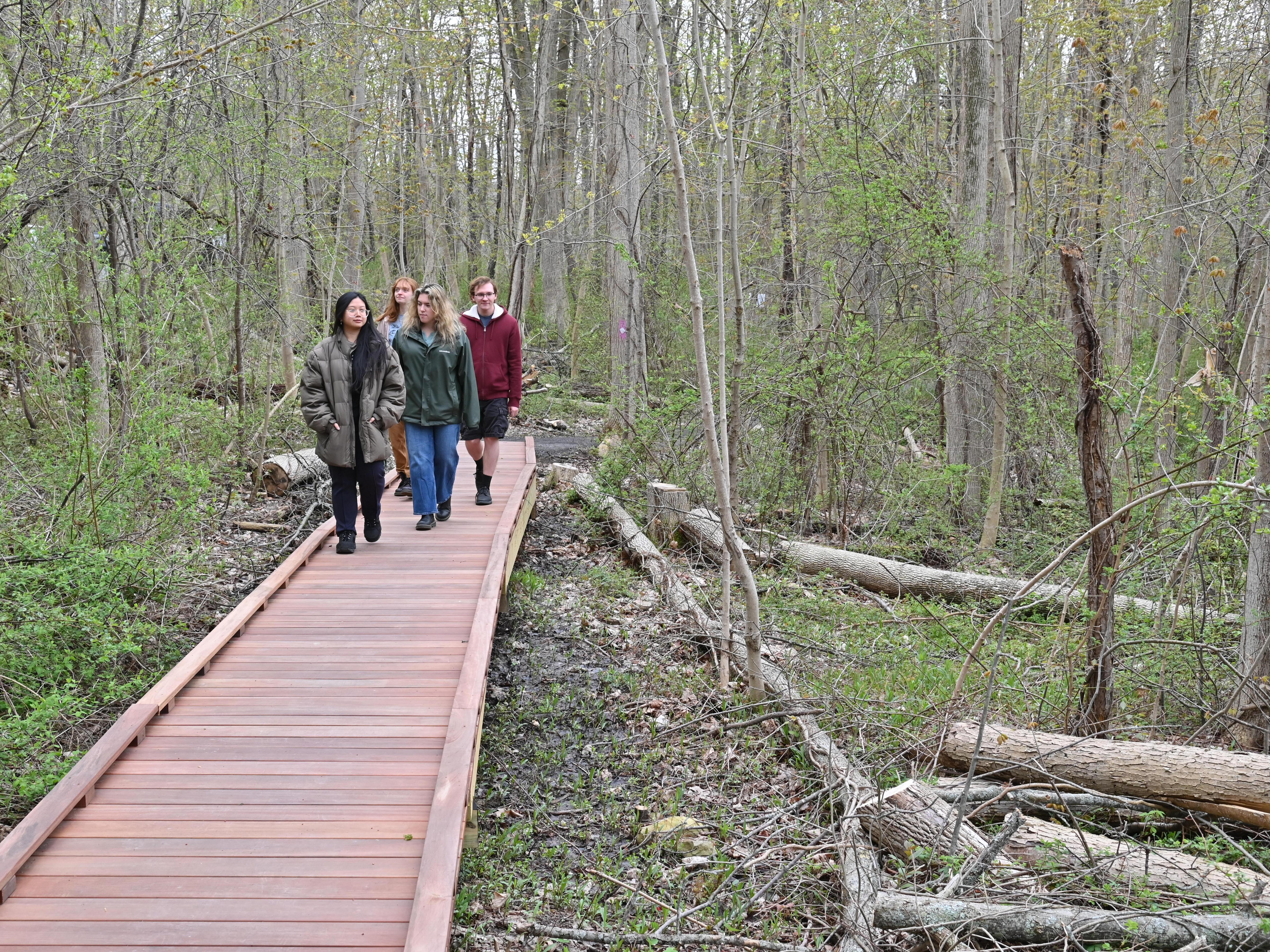
Students attending the grand opening celebration of Rice Creek Field Station's new accessible Purple Trail take a quick stroll.
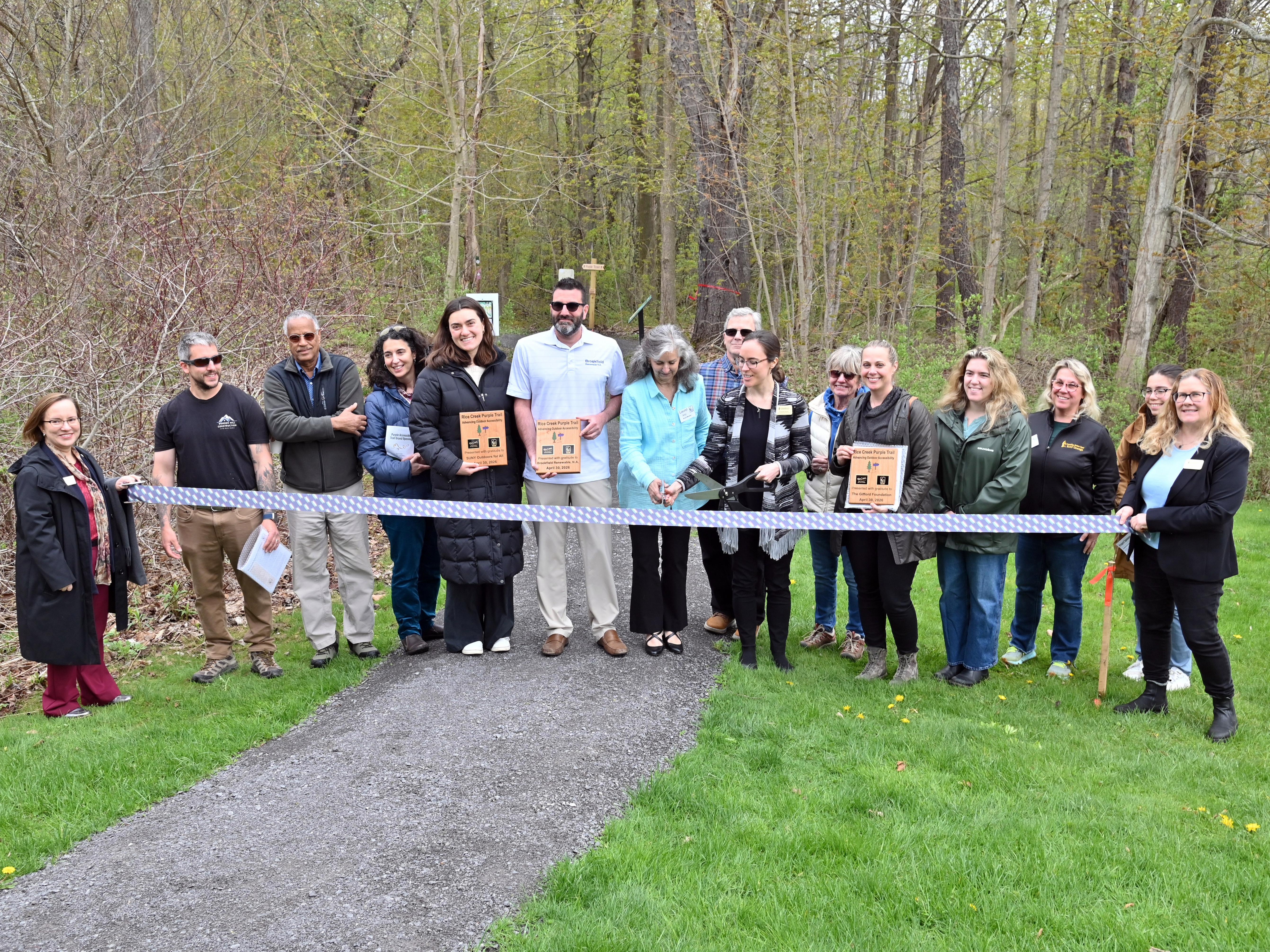
An April 30 grand opening celebrated the new accessible Purple Trail at SUNY Oswego's Rice Creek Field Station as a statement on the importance of inclusion in outdoor opportunities.
The 0.6-mile Purple Trail is designed to promote inclusive access to nature, featuring gentle slopes and stable, flat surfaces of packed stone dust and boardwalks. Meeting U.S. Forest Service Trail Accessibility Guidelines, the Purple Trail is suitable for many people who use wheelchairs, walkers and strollers, and provides an enhanced experience for all visitors.
During the ceremony, Kristen Croyle, dean of SUNY Oswego’s College of Liberal Arts, Sciences and Engineering. said that sharing the gem that is Rice Creek with people of all abilities benefits everybody.
“It represents the best of what we have to offer to each other in making this a resource that is truly for everyone in our community,” Croyle said.
Elizabeth Mulle, a SUNY Oswego double major in geology and in global and international studies who serves as a SUNY Disability Ambassador, said the opening of the Purple Trail was an exciting and significant development.
“By creating a trail that follows accessibility guidelines, the outdoors have become much more available and accessible to people who may not have been able to hike or be outside for long,” Mulle said.
“Seeing initiatives like this at Oswego has helped students with disabilities like me not only feel seen, but more importantly, feel more heard,” Mulle said. “Being able to volunteer and help a little to make this trail a reality has been extremely fulfilling and a wonderful process to be a part of, and I cannot express my gratitude enough for the people involved and the donors responsible for the creation of this new trail.”
Mulle also brought remarks from fellow Disability Ambassador Luis Perez-Rivera, who was unable to attend the ceremony, which included: “To be seen and recognized as a person with a disability and given a space that directly challenges the norm of a world that is traditionally built without accessibility in mind, saying I feel thankful does not scratch the surface. Let this achievement be the first of many that will continue to push this world in the direction of acceptance and love amongst people within it.”
Inclusive campus
SUNY Oswego President Peter O. Nwosu extended a welcome from the university with ”the appreciation we have for engaging in this very important project that creates access,” reflecting the university’s leadership role in the community and the region as an inclusive campus.
”The grand opening of this trail speaks volumes about that commitment,” President Nwosu noted. “I want to thank everyone who came from far and near to be part of it. I do also want to, in particular, extend a very deep appreciation to those who have worked very hard to provide the funding to support this work.”
Construction of the new trail cost around $120,000 but was possible thanks to generous sponsors including SUNY’s Outdoors for All program, Rice Creek Associates, the Shineman Endowed Fund at SUNY Oswego, the Richard S. Shineman Foundation, the Gifford Foundation, Brookfield Renewable and lumber donations from Worden Hill Construction. Other funders included Daniel Pease and Lisa Lazek, the Andromeda Foundation, an anonymous family foundation and the late Barbara Shineman.
On-campus support included SUNY Oswego’s Office of Research and Sponsored Programs, Facilities Services and University Advancement, plus Rice Creek Field Station staff, with groundskeeper Tom Neill providing a countless amount of time and energy.
Those involved in construction and design also included Andrew Bailey Custom Woodworking, recent SUNY Oswego alum Zandyr Meakin, C&S Engineers, Raffa Landscaping and Design, and Worden Hill Construction.
Community support
In addition to the trail’s sponsors and those who constructed and maintain it, Kristen Haynes, assistant director of Rice Creek Field Station, expressed appreciation to members of the campus and community who wrote letters in support of the project and provided advice and encouragement, notably the Rice Creek Associates accessible trails subcommittee.
“I also want to thank the students and student volunteers who evaluated our trail very carefully every five feet to form a baseline impression of the accessibility of the trail, and all the students who helped afterwards with installing signs, advertising and other ways,” Haynes said.
Haynes also praised the prospective Eagle Scout project of Derek Grindle of Oswego, as his Boy Scout Troop 780 and their families helped rebuild bridges on the Green Trail to accessibility standards a few years ago and showed that this larger initiative was possible.
“Today is just the beginning, and we hope you and your organizations will remain partners and supporters,” Haynes said. “We hope you will visit the trail, spread the word and involve your organizations and departments in partner programs or volunteer opportunities.“
SUNY Oswego’s Rice Creek Field Station is a living laboratory supporting academic instruction, research and public service in the natural sciences and environmental education. Located on Thompson Road about a mile south of the main campus entrance, the facility's trails are open from dawn to dusk year-round. For more information, visit oswego.edu/rice-creek.