




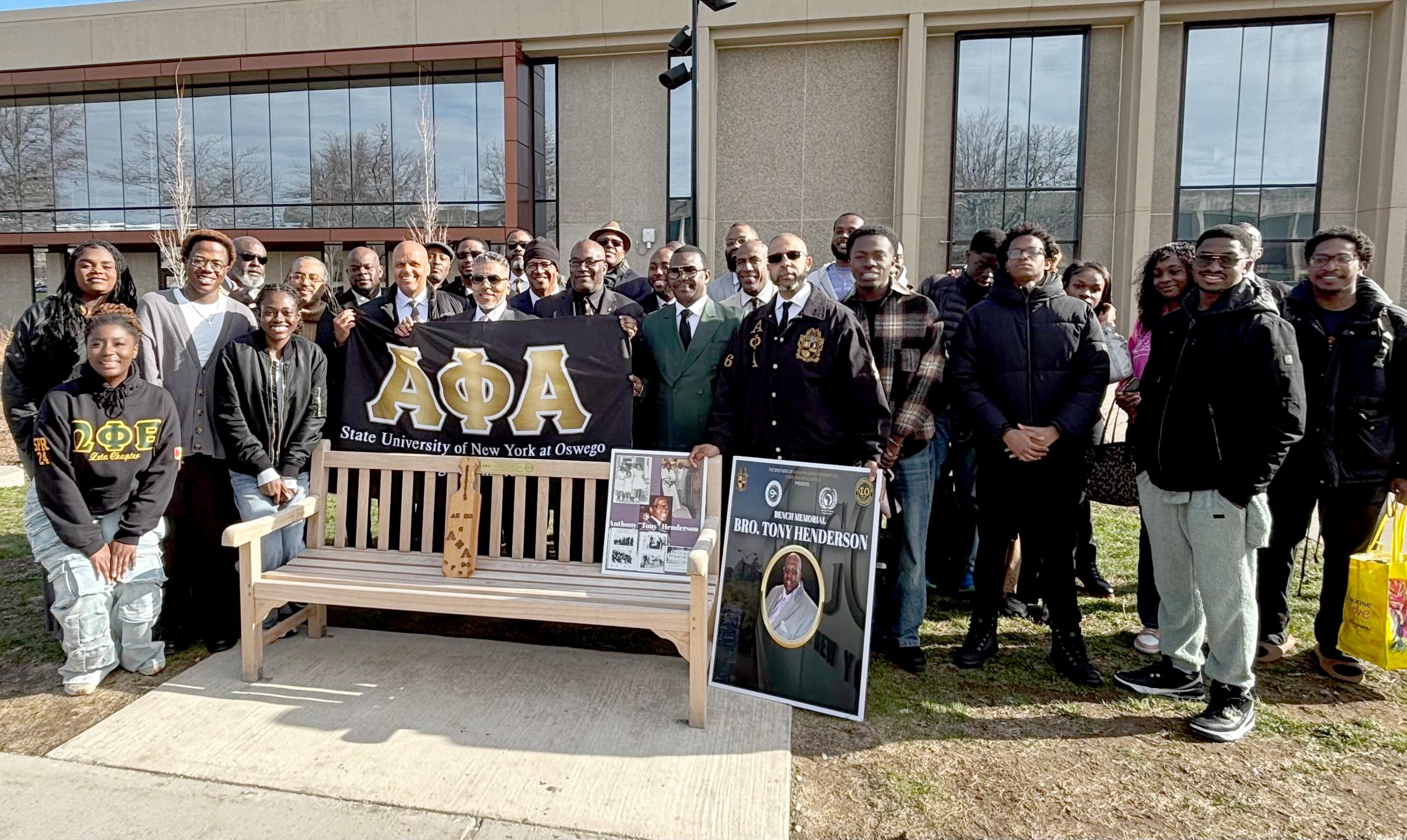
Members of Alpha Phi Alpha, the African Student Organization and more gather for the dedication of a bench to longtime residence hall director and mentor Tony Henderson.
Earlier this spring, SUNY Oswego students, alumni and faculty gathered for the dedication of the Anthony “Tony” Henderson Bench — a tribute not just to a man, but to a legacy that had shaped generations.
After Henderson’s passing in 2023, Lionel Lee of the Class of 1993 and Alpha Phi Alpha brotherhood initiated a fundraising goal to raise enough money for a memorial bench on SUNY Oswego campus in September 2024. After the fundraising goal was accomplished, Henderson became the first residence hall director to receive a bench in remembrance.
As people gathered around the bench on April 11 for the ceremony, conversations turned into stories. For many, Henderson had been more than a staff member — he had been a constant. Henderson was known for his role on campus serving 25 years as residence hall director and as a mentor to the Alpha Phi Alpha brotherhood.
Organized by Lee with assistance from African Student Organization, the event marked how Henderson's influence extended into brotherhood and leadership. Lee reflected on how he helped bring Alpha Phi Alpha fraternity to Oswego and ensured it thrived, but emphasized that his reach went far beyond any one organization.
“Mr. H was truly an incredible man who touched the lives of so many during his time at SUNY Oswego,” Lee began. “He wore many hats on campus — serving as a mentor, a listener and a steady presence for students navigating both challenges and growth.”
Lee, along with many of the brothers, looked up to Henderson as a father figure who offered guidance in navigating campus life.
“At the same time, Mr. H held high expectations. He was firm and honest, never hesitating to provide tough feedback when he saw someone falling short of their potential,” Lee said. “Beneath that tough exterior, however, was a man who deeply cared about every person he encountered.”
The balance of discipline and compassion are what so many remember most about Henderson.
Far-reaching impact
“While we honor him today on behalf of Alpha Phi Alpha,” Lee said. “His impact extended far beyond the fraternity, reaching students across campus and shaping countless lives.”
In the crowd stood members of Henderson's family, witnessing firsthand the community he helped build. One by one, attendees approached the bench and spoke about the times Henderson impacted their lives.
Sem Philippe of the Class 2005 was the next Alpha brother to step forward, smiling as he recalled his first impression of Henderson, who was the director of Cayuga Hall at the time.
Philippe shared how Henderson would often tease the brothers by calling them “knuckleheads” and that’s what he hears when he looks at any picture of Henderson.
Philippe went on to say that Henderson urged him and other students to take advantage of the opportunities to lead and learn, with the goal in mind to uphold and continue growing his legacy.
Zelkadis Elvi of the Class of 1991 reflected on his first days at SUNY Oswego with a mix of emotions. He recalled not wanting to live in Riggs Hall at all, especially after visiting campus on a “cold breezy day.” But once he arrived, things quickly shifted.
From being greeted and helped into that first meeting in the TV room, Elvi vividly remembered when Henderson “laid down the law,” pacing back and forth and setting expectations. At the time, it felt intense — “we just got here,” he joked — but looking back, he recognized how those early moments reshaped the culture of Riggs, transforming it into a space of respect and accountability.
Elvi described how his perception changed the more he got to know Henderson. He saw Henderson not just as an authority figure, but as someone generous, attentive and deeply invested in his students. He recalled moments of camaraderie, meetings in Henderson’s residence and even simple acts of trust, like allowing students to use his car — something, he noted, even his own father wouldn’t do.
“I saw him smile one time, and I was like, oh… he’s not as mean as I thought,” Elvi said, drawing quiet laughter. Through those experiences, Riggs became a community unto itself. Closing his reflection, Elvi grew more emotional, reminding the crowd that leadership and mentorship are what Henderson made sure to pass down.
“People look up to us … that’s why we’re here,” Elvi concluded.
Dedication and support
Samuel Bligen III of the Class of 2011 said that even though his interactions with Henderson were minimal, Henderson was a figure people could not only look up to but who always reminded them to stay focused on what they’re accomplishing.
“Whatever it was that you were doing, you do the work, you are dedicated to it,” he said. “And that really stuck with me because collectively, as minorities on campus, you have to be able to support each other, and Tony was the epitome. The foundation for that.”
Bligen recalled wanting to express his gratitude, but Henderson never felt the need to hear it.
“He’d stop me and say, ‘You don’t have to thank me,’” Bligen recalled. “‘Just make sure you’re doing the work.’”
Two-time alumnus Frederick James Jr. -- 2009 as an undergraduate, 2011 as a master's graduate -- reflected on arriving at SUNY Oswego during a difficult period in his life, unsure of himself and not yet seeing his own potential. He credited Henderson with changing that trajectory, pushing him into leadership roles he initially resisted.
Over time, their relationship deepened through shared connections, including ties to Rochester and involvement as Master Masons. Those lessons extended well beyond campus, shaping how James approached life after graduation.
“He reminded me what it’s like to be someone people look up to,” James said, emphasizing that leadership is built through growth, resilience and accountability.
Similarly, 1996 graduate Dorald Bastian described arriving on campus years earlier with that same sense of uncertainty — stepping off a bus far from home, searching for belonging in an unfamiliar environment. Originally from the The Bahamas, he spoke about the importance of representation and the role Henderson played in providing it.
“They [other brothers] loved what Alpha represented to them as Black men, stepping into a world, you know, to take on leadership,” Bastian said. “We needed to understand what it means to be organized, and he brought that to us.”
“This bench tribute is just a small gesture,” Lee added, “to show Mr. H and his family … how much he meant to all of us. You will hear stories that reflect the lasting legacy he leaves behind and the profound influence he had on so many students.”
The ceremony didn’t end when the speeches did. It continued in clusters of conversation — old friends reconnecting, former students sharing memories, laughter breaking through tears. The bench became more than a structure; it became a gathering force, just as Henderson had always been.
-- Written by Emily Sosa of the Class of 2026 for University Advancement