




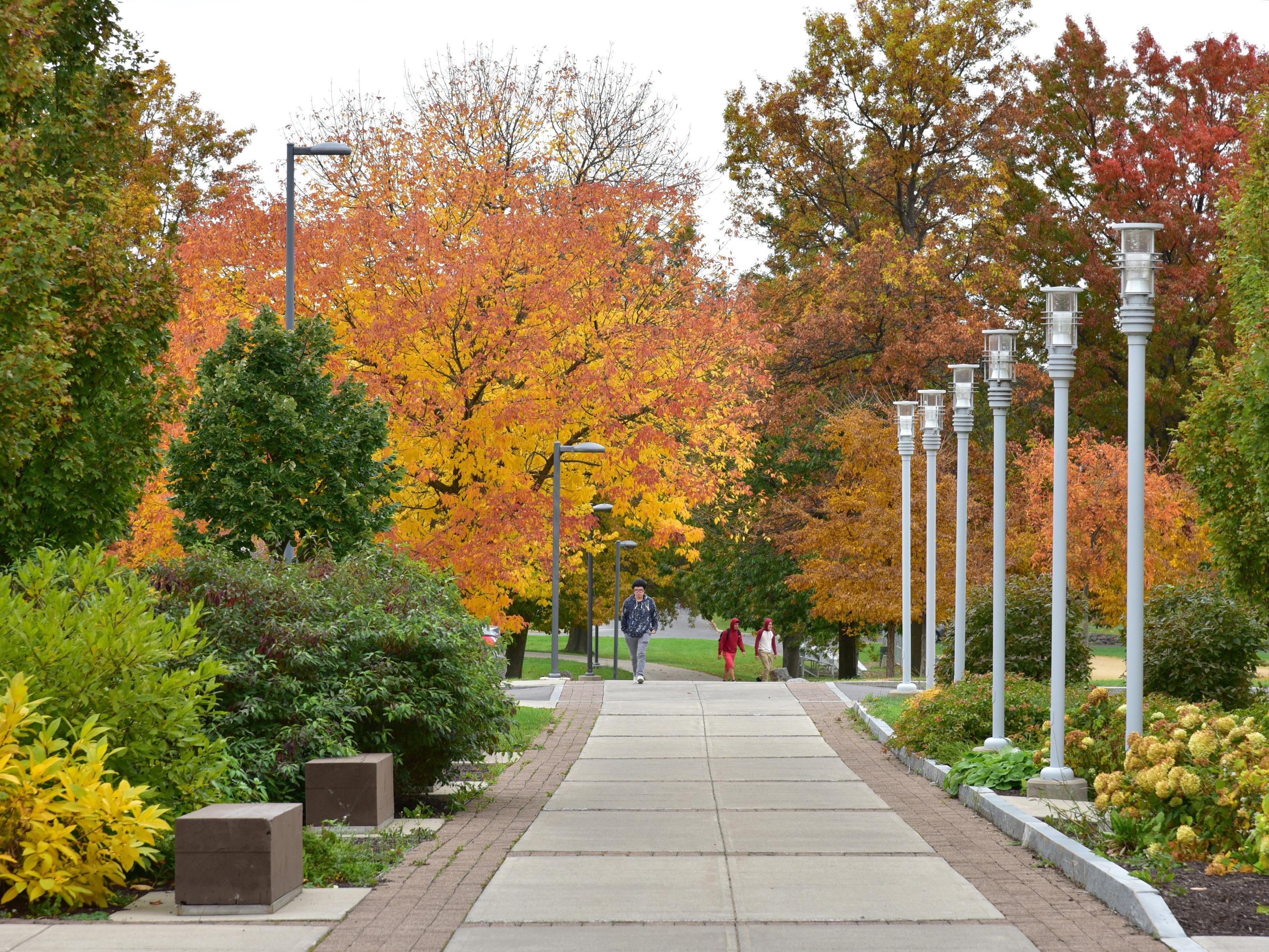
From shelter from the summer sun to the splendor of autumn leaves to supporting animals and an ecosystem, SUNY Oswego's trees are a signature part of campus. A new Tree Hall of Fame seeks nominations in recognizing the role and stories of these campus features.
SUNY Oswego is establishing a new Tree Hall of Fame, celebrating trees of exceptional ecological, historical, cultural and personal significance.
Calling trees the “longest-living Lakers” on campus, the Office of Sustainability noted that this effort dovetails with the university’s recognition as a Tree Campus USA institution given its dedication to trees and the natural environment. The Campus Environmental Action Committee (CEAC) brought the idea from concept to reality and will process the nominations.
Students, faculty and staff members can use this nomination form for their favorite trees across campus by the April 6 deadline.
The project encourages the campus community to enjoy the outdoors more while gaining an appreciation for trees and the university's natural setting.
“We look forward to sharing the stories behind these important trees,” Sustainability Director Kate Spector said. “It allows a fun way to build stewardship, boost campus pride and have a chance to learn about trees along the way.”
The first nominees will be announced during Earth Week 2026 in April.
Eric Hellquist, a member of both the biological sciences faculty and the CEAC, has made studying and advocating for trees his life's work.
Trees, he noted, reduce negative influences in the environment while creating positive contributions toward the environment, human wellness and even the economy.
‘One of our most important allies’
“On college campuses and in our communities, trees are one of our most important allies to mitigate the effects of climate heating,” Hellquist noted. “Trees act as living air conditioners that pull carbon dioxide out of the atmosphere, removing carbon dioxide's heating impacts while adding oxygen back into the air.”
Trees store that carbon in their trunks, branches and roots for decades or even centuries, silently playing a key role while also providing other benefits, Hellquist said.
“Trees provide welcome shade that reduces cooling costs of campus buildings while also creating microhabitats that reduce heat island effects adjacent to impermeable surfaces such as roads and parking lots,” Hellquist noted.
“In addition to their environmental benefits, trees also play a meaningful role in supporting human health and well-being,” said Sustainability Coordinator Maxon Ali, one of the organizers of the program and a 2024 SUNY Oswego graduate who gained a passion for the university’s ecosystem.
“Research has shown that access to green spaces and tree cover can help reduce stress, anxiety and depression while improving overall mood,” Ali noted. “On a college campus, these benefits can be highly impactful, offering students, faculty and staff natural spaces for reflection, restoration and connection amid busy schedules. By recognizing trees not only for their longevity and beauty but also for their contributions to human wellness and wildlife benefits, the Tree Hall of Fame program captures a holistic understanding of sustainability.”
"Trees also serve as a natural landmark and help promote place identity and connection to campus," said Cory Brosch, a CEAC member and assistant director of training in Counseling Services. "We, along with trees, are a part of the campus environment, not separate. Being around trees -- either immersed in the woods, taking long walks or simply having a view of trees from a window -- helps to boost concentration and focus in addition to the other wellness benefits already stated."
The initiative, organizers hope, will change how people look at the trees around campus.
"This new program, I hope, in a small way, helps to facilitate a culture of sustainability and appreciation for nature through expanding who and what we give honor and show value," Brosch added.
Among other benefits, trees provide a habitat that fosters food, shelter and protection to a wide array of wildlife.
Trees also provide “free purification services for essential natural resources” by filtering pollutants in the air and water, Hellquist said. “Trees anchor islands of biodiversity that are increasingly important as connective waypoints in human-fragmented landscapes.”
Beyond that, trees are key to the beauty and natural environment that attracts many to SUNY Oswego.
“Trees provide aesthetic beauty that contributes to human well-being and community identity,” Hellquist noted. “As people pass through campus, trees are witnesses to the history that unfolds around them. People can be away from campus for long stretches of time, but trees are tangible connections to place, people and memory.”
Anybody with questions on the Tree Hall of Fame can email sustainability@oswego.edu.