


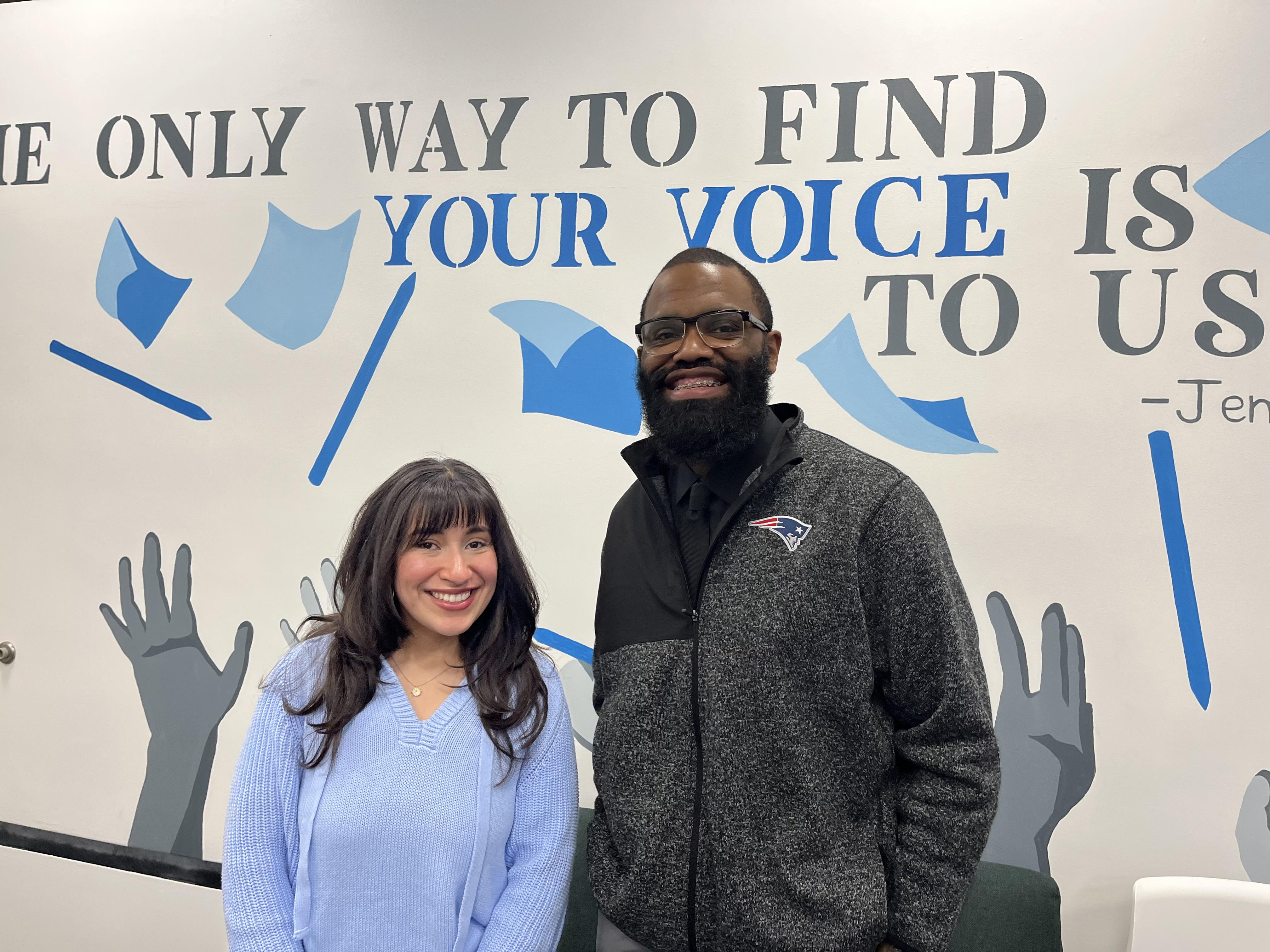
The new TRIO Student Support Services (SSS) staff -- Advisor Jessica Recinos-Peralta and Director Samuel Bligen –- are both SUNY Oswego graduates who are happy to play a key role at their alma mater to help current and future Lakers.
A federal grant will allow SUNY Oswego to add a TRIO Student Support Services (SSS) program to provide financial and advising support to students who are first-generation, face funding challenges and/or have documented disabilities.
The five-year grant from the U.S. Department of Education could provide more than $1.3 million over that span to support this effort, which is a proven model to increase student retention, positive academic standing and graduation rates.
TRIO SSS is available to eligible students who are not in other support programs such as the Educational Opportunity Program (EOP), Advancing Completion through Engagement (ACE) or the Collegiate Science and Technology Entry Program (CSTEP).
Michelle Bandla –- who oversees the program as assistant vice president, academic support –- said that many current students are eligible for TRIO SSS, working to fill 105 slots by March 29 via ongoing outreach efforts, and 140 total for the fall semester.
“Receiving this grant is a tremendous opportunity to find yet another avenue to support our Lakers and guide them toward success,” Bandla said.
Limited spots remain, so students who believe they may meet the eligibility criteria should email TRIO@oswego.edu for more information as soon as possible.
The TRIO SSS staff –- consisting of Director Samuel Bligen and Advisor Jessica Recinos-Peralta –- are both SUNY Oswego graduates who are happy to play a key role at their alma mater to help current and future Lakers.
“When I saw this opportunity, it was almost like a full circle, continuing that path and being able to not only come back to where I was able to flourish as a student, but to continue to support the next generation of young adults coming through,” Bligen said. “And just being able to provide another level of academic and student-based supports to the campus.”
For Recinos-Peralta, it’s an opportunity to help students while knowing what many of them are going through.
“I know what it's like to have all these barriers in higher education, especially being first-generation, having a disability and coming from a low-income household; those barriers still exist for so many students that prevent them from continuing their higher education,” Recinos-Peralta said. “Because I know what that's like and how that feels, I feel like I could also help advocate for them the same way that I was advocated for and pushed to continue.”
“Having two alumni who have expertise and empathy like Samual and Jessica establishing the program is a tremendous start,” Bandla said. “That they care so much about students and building a culture of success means we’re starting with a solid foundation.”
Filling a need
Bandla and Scott Furlong, then provost and vice president for academic affairs, applied for the grant and earned a score of 113, the highest a non-current program can receive in this competitive process.
Oswego saw TRIO SSS as a way “to close equity gaps in retention, academic performance and graduation for a large eligible student population,” according to the university’s application. “The program model is intensive, data-driven and highly collaborative, centered on structured advising, tutoring, financial literacy, mental health support and career/graduate school preparation.”
Services provided to TRIO SSS students will include advising and coaching sessions, scholarship and Free Application for Federal Student Aid (FAFSA) and financial literacy education, personal counseling and academic coaching, tutoring, career development and experiential learning support, programs to build belonging and engagement, and graduate school exploration and preparation opportunities.
The university serves a large Pell Grant-eligible student population who can benefit from any services available, so Bandla is pleased to see another avenue to help students succeed.
Thinking back to his own experience, Bligen sees how opportunity programs can help students not only survive, but thrive.
“I was an EOP student and having that opportunity to go through that program and get those levels of support really helped me flourish in a way where I don't know where I would have been without those programs and those individuals who really supported me,” he recalled.
Paying it forward
“Having those supports really meant a lot to me, resonated with me, and I always wanted to pay it forward and be in a place where I'm able to help students,” Bligen said. “I've had the opportunity to work and collaborate with other TRIO programs on other campuses, so I jumped at the opportunity to strengthen the academic assistance in place, and the student service supports that are in place.”
Recinos-Peralta cites her undergraduate advisor, Sandy Bargainnier in wellness management, and graduate advisor, Peter Ghazarian in the higher education leadership program, from which she will earn her master’s in May, for being role models she can draw on as she works with Oswego students.
“I want them to feel advocated for, feel supported, to know that they can always email or come to us and say they need help, because it's already hard to ask for help if there are a lot of barriers,” Recinos-Peralta said of the students she looks forward to serving. “Creating a space for them where they can always ask for help and for them to feel safe and welcomed and included is important. I want our students to always feel like they have a seat at the table, where they can speak and be listened to.”
“I think establishing a culture is going to be one of our biggest things,” Bligen said. “How do we align and match up with a lot of the already established student support programs on campus? How do we create an alliance? Because it's not a competition, but I think it’s about understanding the difference between the respective programs, like TRIO SSS or ACE or EOP.“
They also noted that student retention is a key consideration of President Peter O. Nwosu’s Vision 4040 plan, and its push for equity dovetails with TRIO SSS.
“You can’t have a one-size-fits-all program, as we know that that doesn't work for everybody,” Recinos-Peralta said. “The retention piece is big, especially because if we're looking at Vision 4040, that's part of the mission where we want to continue to grow retention and we want to continue being inclusive. I think programs like this can help bridge those gaps and help students stay and succeed.”
“I think about being able to build a really strong sense of community,” Bligen said. “It's something that I think about in talking about my experience as a student and now a professional, and in Jessica's experience as a student transitioning into that professional dynamic, and for our program as a whole. We’re just looking forward to building these really strong resources on campus and being able to be a stronger campus.”