


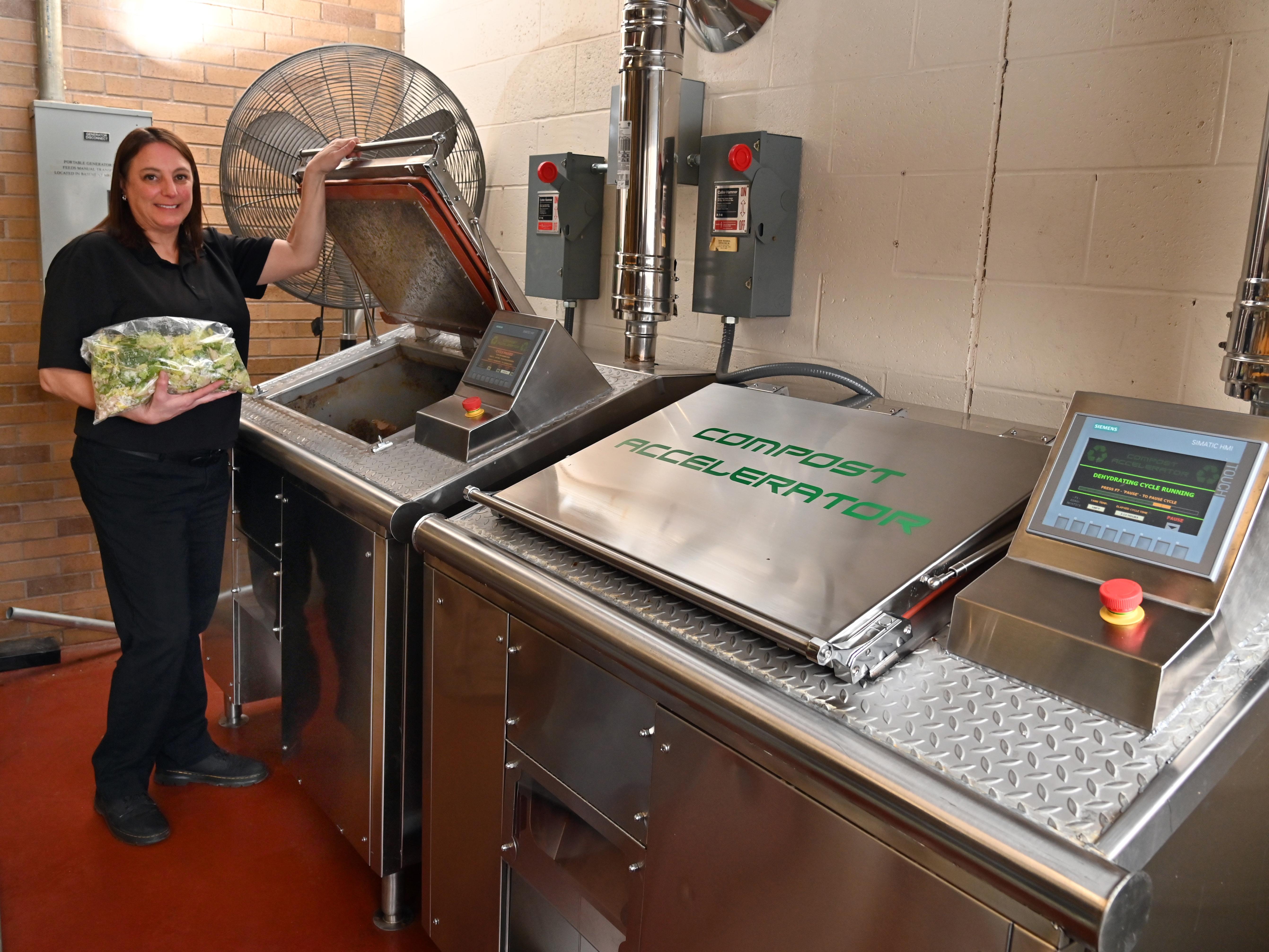
Kelly McKinney, Lakeside Dining Hall building manager, shows the grant-funded new food dehydrator that greatly reduces food waste. The grant came from New York State Association for Reduction, Reuse and Recycling and the New York State Pollution Prevention Institute.
Two top statewide supporters of sustainability provided SUNY Oswego with a $2,500 grant to help expand campus composting and waste-reduction efforts.
The grant came from the New York State Association for Reduction, Reuse and Recycling (NYSAR3) and the New York State Pollution Prevention Institute (NYSP2I) through a program supporting New York State universities and colleges that are members of the NYSAR3 College Council. These grants empower innovative projects focused on source reduction, reuse, recycling and pollution prevention.
Titled “The SUNY Oswego Community Composting Rollout,” the Office of Sustainability project involves a campus-wide post-consumer composting initiative aimed at diverting food waste from landfills and educating students about sustainable waste management.
The food dehydrators will divert around 600,000 pounds from the waste stream per year, said Stephen McAfee, assistant vice president of student affairs and general manager of Auxiliary Services.
“The amount of waste reduction achievable by using food dehydrators to compact the matter is tremendous,” said Kate Spector, sustainability director for SUNY Oswego. “This grant will go a long way toward our ongoing efforts to reduce waste and our impact on the environment.”
While pre-consumer composting is already established in dining and retail facilities, this project expands efforts to include post-consumer waste generated at residential dining halls.
“Our goal is to build lasting, collective habits that make composting a natural part of daily life at Oswego,” said Maxon Ali, SUNY Oswego sustainability coordinator.
Through a comprehensive student engagement campaign, this project aims to educate and empower students to properly sort their food waste, directly supporting campus composting systems and advancing broader sustainability goals. By promoting responsible waste sorting practices, the initiative can not only reduce food waste and associated greenhouse gas emissions but also foster a deeper understanding of sustainable living among students.
This initiative represents a thoughtful integration of key sustainability strategies — composting, source reduction and behavioral change — and contributes to a more circular campus economy. By keeping organic materials in the nutrient cycle rather than sending them to landfills, the project reinforces the value of resource recovery and long-term environmental stewardship.
“At SUNY Oswego, we are honored to receive the NYSAR3 College Council Grant Award on behalf of our campus community,” Ali noted. “We extend a sincere thank you to NYSP2I, as this support will strengthen our post-consumer composting initiative by helping us engage students and staff through education, clear signage, and meaningful conversations. We’re excited to continue advancing our waste reduction efforts — having made great strides since launching pre-consumer compost collection in fall 2021.”
The mission of the New York State Association of Reduction, Reuse and Recycling is to provide statewide leadership on waste reduction, reuse and recycling issues and practices to improve the environment.
Funded by the New York State Department of Environmental Conservation, the New York State Pollution Prevention Institute is led by the Golisano Institute for Sustainability at Rochester Institute of Technology (RIT) and is a partnership between RIT, Binghamton University, Clarkson University, Cornell University, Rensselaer Polytechnic Institute and the NYS Manufacturing Extension Partnership. NYSP2I’s mission is to make the state more sustainable for workers, the public, the environment, and the economy through pollution prevention.
For more information about SUNY Oswego sustainability initiatives and programs, visit oswego.edu/sustainability.