



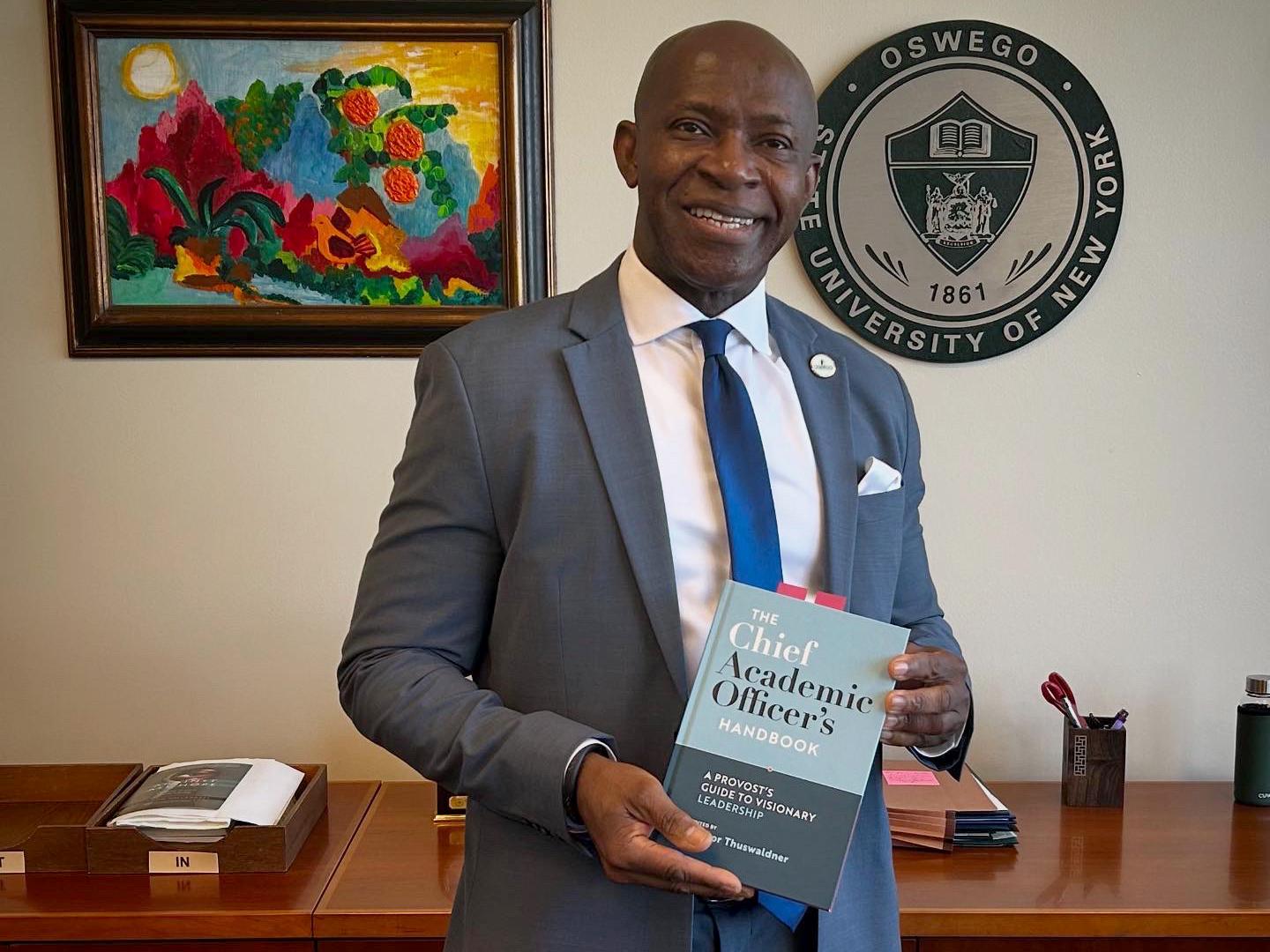
President Peter O. Nwosu has contributed to national conversations on higher education leadership through authoring two chapters in “The Chief Academic Officers Handbook,” published by Johns Hopkins University Press in collaboration with the Association of Chief Academic Officers.
SUNY Oswego President Peter O. Nwosu continues to elevate the university’s profile and expand its impact through two recent milestones: his appointment to the Presidents’ Leadership Council of the California-based Educational Credit Management Corporation (ECMC) Foundation, a national philanthropic organization, and his authorship of two chapters in a national academic leadership handbook.
National leadership appointment
Last month, President Nwosu was invited to join the ECMC Foundation’s newly formed Presidents’ Leadership Council. The foundation’s mission is to improve postsecondary career success among underserved populations through evidence-based innovation and to advance student success in higher education.
“I am honored to have the opportunity to join other top leaders in higher education to offer insights and suggestions for this important effort,” President Nwosu said. “Providing access and pathways for transformation are at the heart of the mission of SUNY Oswego and other public universities and colleges. The ECMC Foundation is an important champion of this cause, so I am happy to serve.”
Amid ongoing challenges facing public colleges and universities, the ECMC Foundation is convening presidents to share expertise and identify opportunities for higher education and the philanthropic community to better address students' needs — particularly those furthest from opportunity.
The council’s work, including an initial virtual meeting later this month, focuses on developing collaborative strategies to eliminate gaps in students’ credential completion and advance students’ economic and social mobility.
Other members of the new council include Mildred Garcia, Chancellor, California State University System in California; James Manor, Chancellor, Southern Illinois University in Edwardsville, Illinois; DeRionne P. Pollard, President and CEO, American Association of Community Colleges (AACC), based in Washington, D.C.; Madeline Pumariega, President, Miami Dade College in Florida, Scott Rails, President, Wake Tech College in North Carolina; Jose Luis Cruz Rivera, President, Northern Arizona University in Arizona; Charles L. Welch, President and CEO, American Association of State Colleges and Universities (AASCU), based in Washington, D.C.; and David Wilson, President, Morgan State University in Maryland.
Contributing to national scholarship
At the same time, President Nwosu is contributing to national conversations on higher education leadership through two chapters in “The Chief Academic Officers Handbook,” published by Johns Hopkins University Press in collaboration with the Association of Chief Academic Officers.
His chapters “Leading Institutional Transformation” and “Developing Your Bench: The Role of the Chief Academic Officer” were published in the handbook. The latter was co-authored with Kathy E. Johnson, president of the University of New Orleans. The chapters draw on Nwosu’s experience at CUNY’s Herbert H. Lehman College and Clark Atlanta University, as well as his ongoing research and leadership practice.
Reflecting on his tenure as provost and senior vice president for academic affairs and student success at Lehman College, President Nwosu describes how focusing on a dozen interconnected themes — including enrollment and access, innovative pedagogy, technology, and external partnerships — produced transformational results.
“Remember that institutional transformation requires courageous leadership and involves realigning the institution’s structures, culture, and business model to create the student experience that delivers dramatic and equitable increases in outcomes and educational value,” President Nwosu wrote. “Tinkering at the margins will not transform your institution.”
That philosophy continues to guide his work at SUNY Oswego. The university’s Vision 4040: Expanding SUNY Oswego’s Promise sets a bold goal of doubling the number of degrees and credentials awarded annually to 4,000 by 2040, strengthening service to students and advancing the talent needs of the region. Recent realignment of academic offerings — including the 2025 transformation of the university’s four colleges — reflects this commitment to expanding opportunities for students, faculty, and community engagement.
“Identify the problem, but frame it as an opportunity,” he also wrote. “It is always important to ask, ‘What problems are we trying to solve?’ Establishing clarity and agreement on the problem is the first step. But it’s important that the conversation be framed not as a problem but as an opportunity to advance the institution’s mission.”
While transformational initiatives must be championed by institutional leadership, President Nwosu emphasizes that broad campus engagement is essential for lasting success.