



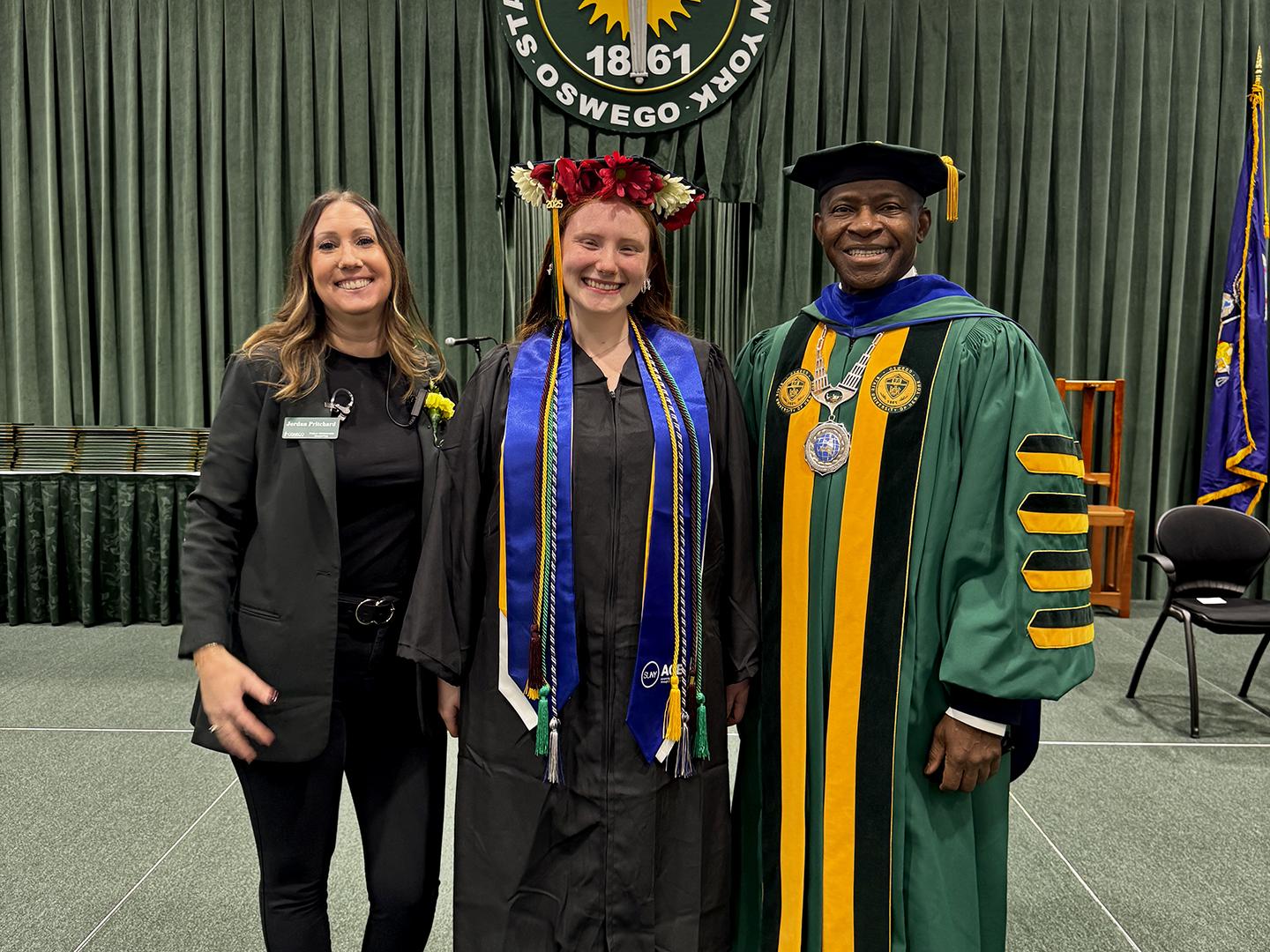
ACE (Advancing Completion through Engagement) Program Director Jordan Pritchard with the program's first graduate, Emily Colledge, and SUNY Oswego President Peter O. Nwosu at December 2025 Commencement.
Crossing the stage of Commencement is a milestone for any college graduate, but when Emily Colledge graduated in December 2025, she became the first of many more participants in the Advancing Completion through Engagement (ACE) program to do so.
“Seeing Emily cross the stage as the first ACE graduate was extremely exciting,” said Jordan Pritchard, ACE program director. “We take time to build relationships with each student in the program, so their accomplishments mean a lot to us. I witness the time and dedication the ACE Advisors give to this program, putting their students first day after day. Having the program's first graduate is encouraging, knowing that all our efforts are positively impacting our students.”
SUNY’s ACE program provides students with the support they need to finish their degrees on time. The supports include funding to cover textbooks and other costs of attendance, academic assistance, comprehensive personalized advisement and career development activities. The program focuses on high-risk populations who often navigate substantial barriers on their path to academic success. That includes first-generation, Pell-eligible or transfer students, or students from underrepresented backgrounds.
While Colledge said she imagined herself completing her bachelor’s degree, the ACE program helped ensure she did so and gave her a confidence boost that made her Oswego experience richer.
Colledge, who hails from nearby Brewerton, began her college career as a vocal music major at Onondaga Community College before transferring to Fredonia to pursue music therapy. There, she faced academic and personal challenges that ultimately led her to withdraw and seek a more supportive environment closer to home. She transferred to SUNY Oswego in fall 2024 as a psychology major with a minor in expressive arts therapy — a program that allowed her to integrate music, writing, movement and art into her academic path.
“I vividly remember I was in Lanigan, and I was sitting on one of the couches, and I was going through my emails between classes when I saw the email about applying for the ACE program,” Colledge said.
After consulting with her family, including her sister, Abigail -- who will graduate from Oswego this year -- she decided to give it a try.
Through ACE, she received monthly stipend assistance that helped cover meals, textbooks and course materials, as well as individualized guidance from an academic advisor that helped her navigate academic requirements, complete an independent study and stay motivated during challenging periods.
Colledge was assigned to Stephanie Keltz, her ACE academic advisor who explained the services available as well as the expectations of the program, such as meeting with her advisor at least four times a semester or attending an ACE workshop.
'Personal connection'
“I loved having the personal connection to Stephanie,” Colledge said.
In addition to troubleshooting and brainstorming with her, Colledge said Keltz became a friendly face she could count on and be accountable to.
“I could go to her and say this is what's going on, and sometimes we didn't talk about academics,” Colledge said. “Sometimes I just went in and we'd chat, and she's like, ‘so how's your sister, how's your family?’ And it was really nice to have that.
“I think I would have completed my degree without the program, but I think in the harder moments of this semester, like falling into that slump, it was much easier for me to bounce back having the program," Colledge added. "It provided that extra support that really helped push me forward, where I probably would have dragged my feet a little more.”
SUNY Oswego has 409 students enrolled — the largest ACE program across SUNY, according to Pritchard. ACE is supported by the SUNY Transformation Fund in addition to some outside funding sources: JFEW (Jewish Foundation of Education of Women) and Robin Hood.
The pilot started in spring 2024 with 35 students, and SUNY Oswego’s first, full official cohort of 375 began in Ffll 2024. The early results are promising.
“The results of ACE are showing the program is effective, especially for the students we want to reach the most,” Pritchard said. “A large number of our students come from high-risk populations who often face an abundance of barriers when it comes to academic success. ACE students among these populations are achieving higher GPAs, earning more credits, and have a significantly higher retention rate than their peers: 84 percent of our ACE students from these populations came back to Oswego their second year, compared to the 69 percent of similar students from these populations not enrolled in the program.”
The ACE program provides additional financial resources, advising staff and academic and professional development events to give these students the best chance at success.
“We've heard from students that ACE has provided them with a deeper level of support, and without it, they might not have gotten through some of the challenges they've faced during their college career,” Pritchard said. “We make sure our students know that we're by their sides and they can come to us for anything. If we don't have the answer to something, we'll get them connected with someone who does.”
Colledge confirmed that was exactly how she felt.
“Personally, I think ACE helped a lot of students, because I saw a lot of students coming in and using their ACE advisors to get help and direct them to a person in financial aid or career services or internships or getting involved in activities or whatever,” she said. “So, our support wasn’t just our ACE advisor; it spiderwebbed out to everyone on campus.”
As Colledge looks toward her future, she said she is grateful to have been part of the ACE program.
“I actually figured out a lot about myself during this time at Oswego,” Colledge said. “I thought I was dead set on going the expressive arts therapy route, but through my conversations with so many people, I figured out that special education is the route I want to pursue.
“As the first ACE graduate, I hope that I honor the program,” she said. “I hope I set a good example for others to follow. College is hard. This program provides support that previous students have wished they had had. And that’s a good thing. We always want the next generation to have it better than we had, because that's — that's kind of what we're supposed to do. We're supposed to help the next people. That's what I want to do — help the next students get to a place where they feel like they're meeting their capabilities.”
For more information on the program, visit the ACE website.